
What I Learnt From Listening to Management Interviews Today
October 5, 2026 | StockScans Daily Management Interview Series
Every day, hundreds of things happen in the market.
But very few tell you what management is actually thinking.
Today, I went through 19 management interviews across 15 companies. Seven of them had enough substance to make me stop, think and write down what I would actually track as an investor.
And interestingly, the biggest lesson today wasn't about one company.
It was about where management teams are seeing opportunity, and where they are quietly worried.
Here are my biggest takeaways.
1. Power T&D is beginning to look like a genuine supply-constrained cycle
The strongest commentary today came from KEC International and Transformers & Rectifiers.
And the interesting part wasn't simply that demand is strong.
It was the degree of supply tightness.
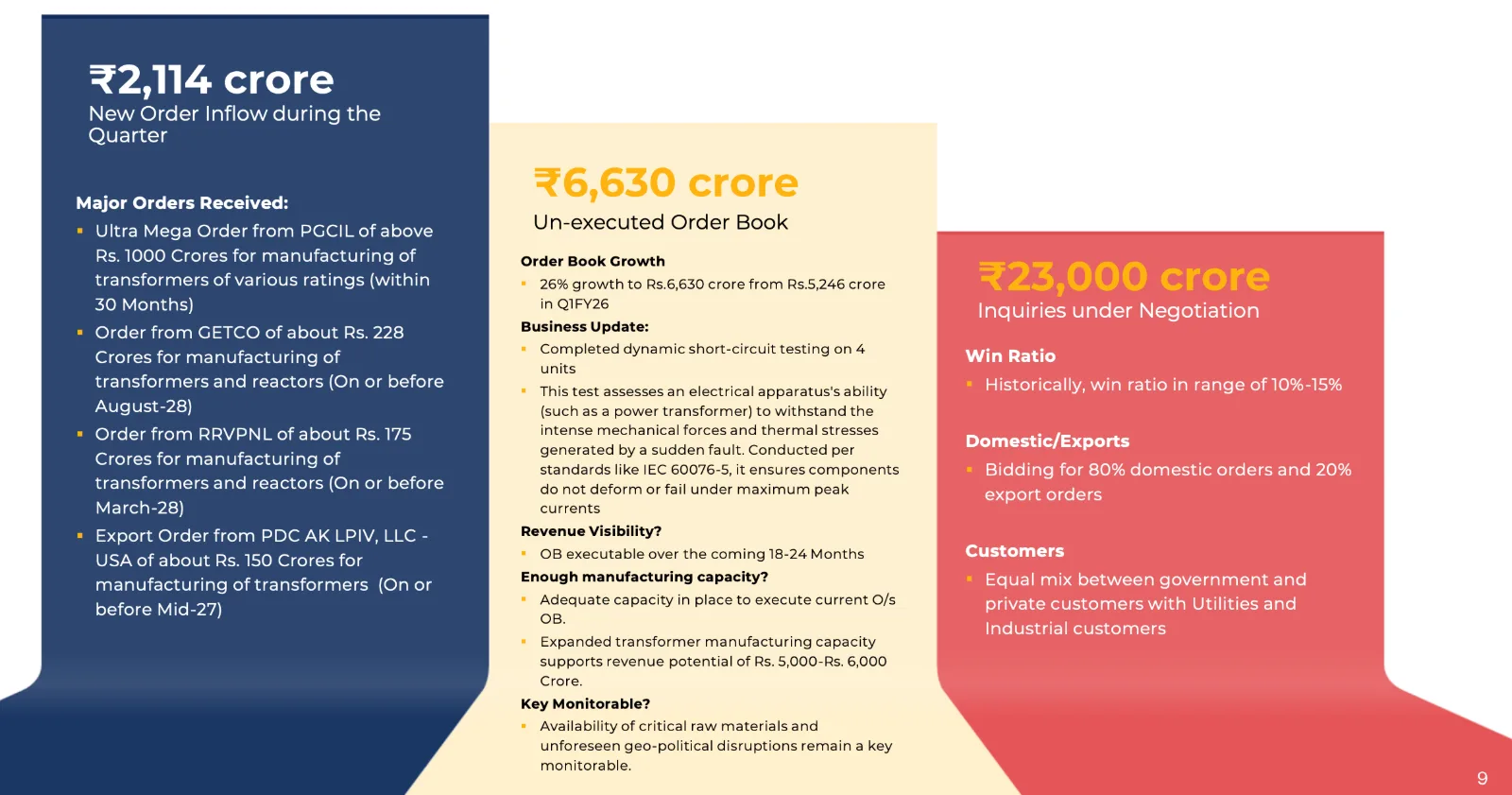
TARIL's management was asked whether they are actually choosing which orders to accept.
The answer? "We have to choose."
That tells you something.
When demand is ahead of manufacturing capacity, the conversation changes from "Can we win orders?" to "Which orders do we want to take?"
TARIL is expanding manufacturing capacity towards 80,000–82,000 MVA.
KEC, meanwhile, continues to defend its 12–15% revenue growth guidance, with management expecting margins to improve as we move into Q3.
What I learnt
The power cycle isn't just an order-book story anymore.
The real opportunity could be the combination of:
strong demand + limited capacity + execution + improving margins.
But this is also where investors need to be careful.
Once industry-wide capacity catches up, today's pricing power can disappear.
What I'm tracking
For KEC: order book conversion and Q3 margins.
For TARIL: capacity expansion, order selectivity and pricing discipline.
Detailed Interview: https://www.youtube.com/watch?v=YJkXmfAMHto
2. Festive demand cannot be judged from one headline number
V2 Retail gave me one of the most interesting management interactions today.
The numbers put management under pressure:
Q2 same-store sales growth: 0.5% versus FY27 guidance: 8–10%.
And first-half revenue growth is also running below the broader full-year expectation.
The interviewer pushed management on this directly.
The response essentially came down to understanding how retail works, seasonality and the importance of the upcoming festive period.
This is exactly the kind of situation where management interviews become useful.
The stock screen tells you there is a gap.
The interview tells you how management thinks about that gap.
What I learnt
In retail, store additions can make reported revenue growth look fantastic.
But eventually you have to come back to one uncomfortable question:
Are the existing stores getting better?
That's why I care much more about SSSG than a headline revenue number.
For V2, the next few quarters matter enormously.
If festive demand comes through strongly, management's guidance can still hold.
If it doesn't, the 8–10% number starts looking increasingly difficult.
What I'm tracking
SSSG > store additions > headline revenue growth.
Detailed Interview: https://www.youtube.com/watch?v=8SBuonVdLmY
3. Management conviction matters
PB Fintech's Yashish Dahiya had an interesting take on the recent market sell-off.
The company saw a significant fall in market value, but his reaction was essentially:
the stock price didn't bother him.
What did bother him was the way the market was interpreting the fall in value.
This is important because founders don't run businesses by looking at today's stock chart.
They look at customers, distribution, market share and long-term economics.
For PB Fintech, the structural opportunity remains tied to increasing insurance penetration and the growth of categories such as health and term insurance.
What I learnt
A management interview can tell you whether a falling stock price is creating business anxiety or only market anxiety.
Those are two very different things.
As investors, we should spend much more time asking:
What I'm tracking
Premium growth, especially health and term insurance, customer acquisition economics and profitability of the distribution engine.
Detailed Interview: https://www.youtube.com/watch?v=GRsr2LB838U
4. The TVS interview reminded me that disruption doesn't always mean abandoning the old technology
Venu Srinivasan's comments on ethanol were particularly interesting.
The market naturally frames the future of mobility as:
ICE → EV
But management commentary reminded me that the transition can be more complicated.
TVS clearly sees opportunities in EVs, alternative fuels and exports, rather than treating them as mutually exclusive paths.
His argument around ethanol adoption was particularly strong, including the example of Brazil and the push towards E10 becoming almost a default rather than a consumer choice.
What I learnt
Technology transitions create opportunities not only for the "final winner".
They also create opportunities for businesses that can adapt their existing technology faster and cheaper.
For an investor, that means not automatically assuming:
EV = only opportunity.
Sometimes the bigger opportunity is in understanding how quickly the existing ecosystem evolves alongside the new one.
What I'm tracking
EV volumes, exports, alternative-fuel adoption and whether these technologies become meaningful volume drivers rather than simply strategic initiatives.
Detailed Interview: https://www.youtube.com/watch?v=osjPe78OoLA
5. Real estate is no longer just about pre-sales
Prestige Estates gave another important lesson today.
The interesting part wasn't only development sales.
It was the increasing importance of rental income and balance-sheet discipline.
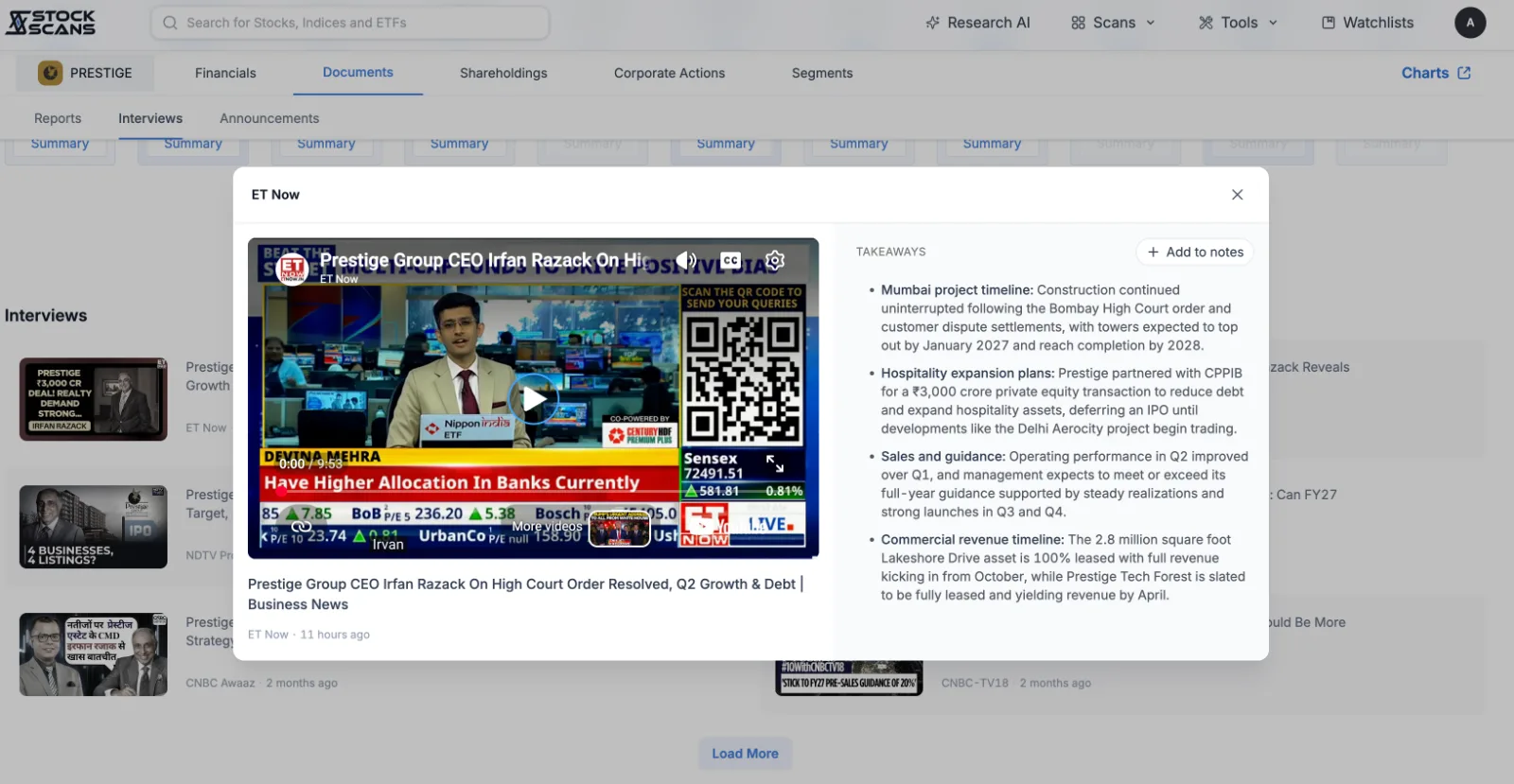
A completed development is now contributing rental income, with management expecting the revenue contribution to come through more fully from October.
At the same time, the interviewer went straight after the elephant in the room:
net debt-to-equity around 0.7x and gross debt of roughly ₹15,000 crore.
That is exactly the question investors should be asking.
Because in a real estate upcycle, growth is easy to celebrate.
The real test is whether that growth eventually produces:
cash flow → deleveraging → stronger balance sheet → higher-quality earnings.
What I learnt
The best real estate stories are increasingly moving from a simple:
"How much will they sell?"
to:
"How much cash will they generate, and what happens to debt?"
Rental annuities make that equation even more interesting.
What I'm tracking
Pre-sales, operating cash flow, rental contribution and net debt-to-equity.
Detailed Interview: https://www.youtube.com/watch?v=Ydu81Krqabs
6. The biggest lesson from today: management interviews help you find the "why"
This is probably my biggest takeaway from going through today's interviews.
A quarterly result tells you what happened.
A scan tells you what is happening.
A management interview often tells you why it is happening, and what management expects next.
And that distinction matters.
Today, six interviews gave seven completely different situations:
TVS: how technology transitions can create multiple growth paths.
PB Fintech: why founder conviction matters during volatility.
KEC: why order-book growth has to eventually show up in margins.
TARIL: what genuine supply-demand imbalance sounds like from the factory floor.
Prestige: why debt and cash flow matter as much as sales in real estate.
V2 Retail: why same-store growth can expose the quality of headline growth.
Why we are building this series at StockScans
I have always believed that investors should spend less time asking:
"Which stock will go up?"
and more time asking:
"What is actually changing inside the business?"
That's what this daily management interview series is about.
Every day, we go through management interviews and extract the pieces that can actually help an investor build or challenge a thesis.
But hidden inside the noise, there are often a few sentences that can completely change how you look at a business.
That's what we're trying to find.
More tomorrow.
Amit
Disc: Not a Buy/Sell Recommendations.
Comments