
What I Learnt From Listening to Management Interviews Today
October 13, 2026 | StockScans Daily Management Interview Series
Six businesses. Six different growth stories.
From Glass Wall Systems' ambitious revenue target to Puravankara's project-launch pipeline, WeWork India's rapid capacity expansion and Swan Defence's long-term shipbuilding opportunity, today's management commentary offers several useful clues about the next phase of business growth.
But growth targets and order books are only the starting point. The real work is to track execution, profitability, cash flows and the assumptions behind management's outlook.
Here's what stood out.
Today's management commentary at a glance
Company |
Key takeaway |
What investors should track |
|---|---|---|
Glass Wall Systems |
₹590 crore revenue target against ₹492 crore last year |
Order execution, segment margins and plant utilisation |
WeWork India |
Rapid desk additions with a dual-engine managed-office and branded-space model |
Occupancy, desk monetisation and lease commitments |
Shiprocket |
Festive demand broadening beyond major marketplaces and metros |
Shipment volumes, seller activity and unit economics |
ESAF Small Finance Bank |
Portfolio shifting towards secured lending while targeting 2% RoA in FY28 |
Asset quality, credit costs and funding costs |
Puravankara |
Strong Q2 pre-sales, but FY27 guidance depends on upcoming launches |
Approvals, launch timing, collections and cash flows |
Swan Defence |
Shipbuilding opportunity supported by government policy and a long industry pipeline |
Order conversion, delivery execution and indigenous sourcing |
KP Green Engineering |
Fresh orders and low current capacity utilisation create room for growth |
Capacity utilisation, execution and operating margins |
1. Glass Wall Systems: Growth is attractive, but can execution keep pace?
Glass Wall Systems is targeting ₹590 crore in turnover this year, compared with ₹492 crore last year. Its ₹982 crore order book provides revenue visibility, with execution expected over 18–24 months and some projects extending into FY29 as new orders are added.
Management estimates the domestic facade market at ₹9,000 crore across major cities, with Tier 2 cities offering additional opportunities. It also believes the industry is consolidating and that Glass Wall ranks among the first three or four players by revenue.
The interesting part: business mix matters
Management expects domestic facade and international facade operations to contribute 40–45% of business each, with fenestration contributing around 10%.
The margin profile it cited is notably different across segments:
Domestic facades: 23–25% EBITDA margin
International facades: 27–28%
Fenestration: around 35%
The planned glass processing plant is another development worth following. The company raised around ₹60 crore through its IPO to bring toughening, cutting and lamination in-house for its own requirements.
What could go wrong?
The key questions are whether the company can execute its growing order book on time, commission the plant effectively and sustain its margins as volumes rise. Management says freight, tariff and customs costs are passed through to customers and that annual margins should not decline; actual results will show how effectively that protection works.
What to track next: Revenue growth, segment-wise margins, working capital requirements, plant commissioning and cash conversion.
Detailed Interview: https://www.youtube.com/watch?v=9N-jZY9w-4k
2. WeWork India: Expansion is one thing; occupancy is another
WeWork India is expanding rapidly, with a new Pune location of approximately 2.8 lakh square feet opened at the beginning of the month and another Kharadi location of nearly 1.6 lakh square feet planned with Panchshil. The latter is expected to accommodate roughly 2,500 seats.
Management said it had already opened around 22,000–23,000 desks against an annual target of 20,000–25,000, although the exact figures were presented as estimates in the discussion.
Its growth strategy combines two models: WeWork-branded spaces and managed offices for enterprise clients. Management expects the two to contribute roughly equally to future growth.
Why the managed-office model matters
Management's example of Millennium Towers is revealing: nearly two-thirds of the 1.8 lakh square feet was associated with a managed-office requirement backed by demand from day one.
This illustrates the potential advantage of securing enterprise demand before committing space. However, the economics depend on contract terms, fit-out costs, occupancy, lease obligations and the returns earned on capital deployed.
Management also expects strong occupancy in Q2 despite recent capacity additions, citing demand from global capability centres (GCCs), domestic businesses, AI companies and newer entrants to India.
What could go wrong?
Rapid expansion can create a mismatch between available desks and paying demand. Even if occupancy holds up, investors need to understand how much profit and cash flow the additional space generates after rent, fit-out expenditure and other costs.
What to track next: Occupancy across mature and newly opened centres, revenue per desk, managed-office contribution, lease liabilities, capital expenditure and operating cash flow.
Detailed Interview: https://www.youtube.com/watch?v=aL6lWTtbc34
3. Shiprocket: The festive opportunity is spreading beyond the biggest cities
Shiprocket's festive commentary points towards a broad range of demand drivers, including fashion, personal care, healthcare, small electronics, home décor, home improvement and gifting.
Hyperlocal delivery could also benefit from increased within-city gifting activity during Diwali.
One particularly useful data point: management estimates that Tier 2 and Tier 3 towns account for approximately 60% of activity through the platform, with their contribution steadily increasing.
What this tells us
The opportunity is not restricted to large marketplace sales events. A broad base of direct-to-consumer (D2C) sellers can generate activity across many categories and throughout the festive period.
Management believes inventory movement and seller planning point towards a strong festive season. It also highlighted the growing focus among D2C brands on driving sales outside marketplaces.
The discussion cited Meesho's first-day festive update: orders up 75%, transacting customers up 60%, sellers up 63% and mall orders up 200% year on year.
These figures provide broader context for festive commerce, but they are not Shiprocket's own operating results.
What could go wrong?
Higher shipment volumes do not automatically translate into stronger economics. Pricing competition, delivery costs, shipment mix, returns and service quality can all affect the profitability of logistics activity.
What to track next: Shipment volumes, revenue growth, seller activity, contribution margins, delivery economics and the sustainability of demand after the festive period.
Detailed Interview: https://www.youtube.com/watch?v=HlLpkOAjyDs
4. ESAF Small Finance Bank: A change in lending mix, with returns still to prove
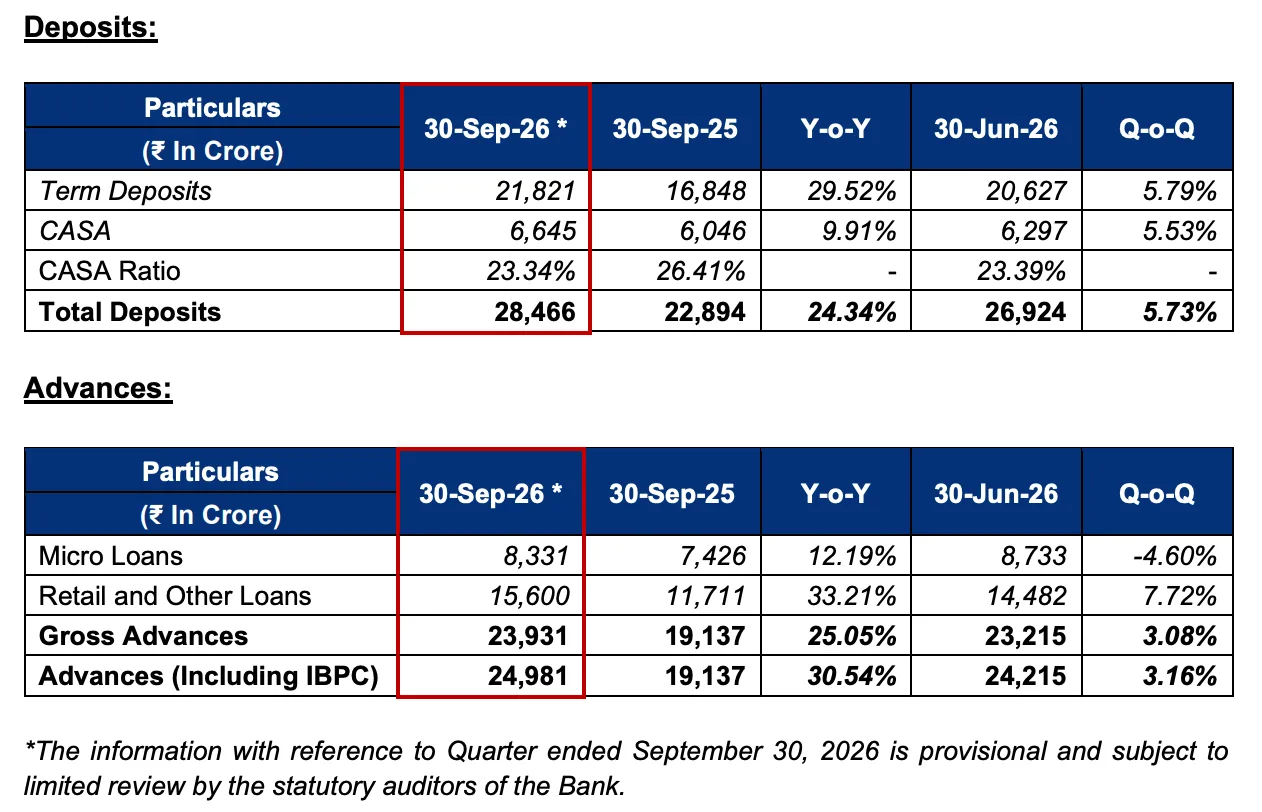
ESAF closed Q2 with asset growth of 25%, within its stated guidance range of 22–25%. Microfinance growth was almost stagnant, while gold, mobility, mortgage and agriculture lending supported the expansion.
The more important development is the shift in portfolio composition.
Management said the bank had moved from a mix of approximately 70% unsecured and 30% secured lending two years ago to 65% secured and 35% unsecured.
Under its MARG strategy micro, retail, agriculture and gold the bank intends to increase the contribution of retail and other lending, including gold, MSME and agriculture, while retaining microfinance as an important part of the business.
Management clarified that it is not abandoning microfinance customers. Instead, it wants to serve them through a broader range of secured, individual and livelihood-finance products rather than relying exclusively on unsecured group loans.
The real question: can diversification improve risk-adjusted returns?
A larger secured portfolio may change the bank's risk profile, but the outcome depends on underwriting quality, borrower repayment capacity, collateral realisation and the cost of funding.
ESAF reported term-deposit growth of 29%, with 92% of term deposits coming from retail customers. Management cited a net interest margin (NIM) of 7.9% and expects it to remain above 7%.
Its longer-term aspiration is to achieve a return on assets (RoA) of 2% by FY28, supported by long-term credit costs below 3%. A new core banking system and associated technology investments are also part of its plans.
What could go wrong?
The bank must demonstrate that portfolio diversification produces sustainable asset quality and profitability. Deposit growth is encouraging, but the cost of deposits, credit costs and the performance of newer lending segments will determine whether the returns target is achievable.
What to track next: Slippages, gross and net NPAs, credit costs, NIM, cost of funds, secured-loan growth and progress towards the FY28 RoA aspiration.
Detailed Interview: https://www.youtube.com/watch?v=3VMKpRaQKf8
5. Puravankara: Strong quarterly sales, but the launch calendar is crucial
Puravankara reported Q2 pre-sales of ₹2,136 crore, up from ₹1,322 crore in the corresponding quarter of FY25. Sales volume rose 22% to 1.83 million square feet, while realisation increased from ₹8,814 to ₹11,651 per square foot.
These figures point to a stronger quarter, but the full-year guidance presents a more demanding test.
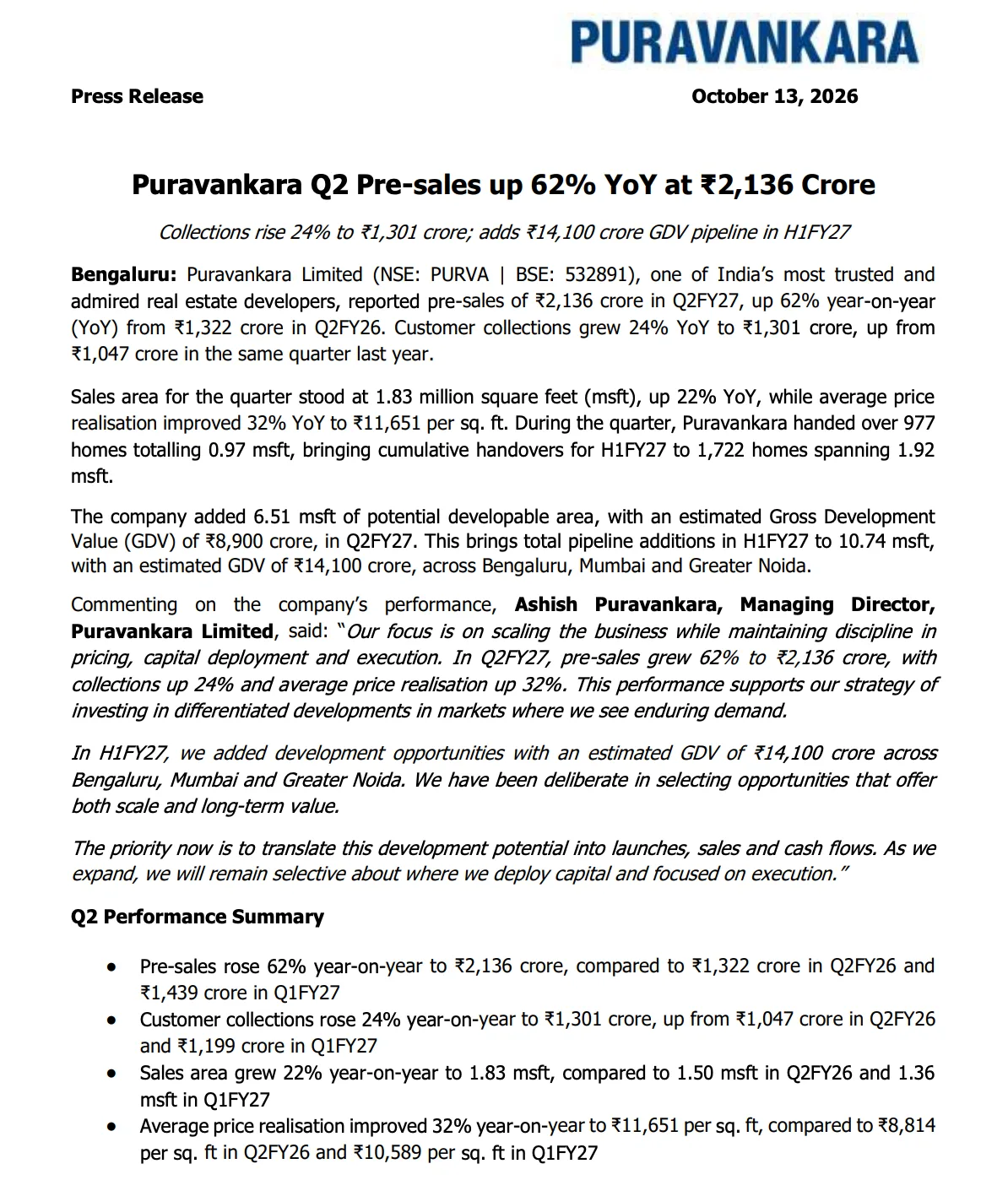
Management retained its FY27 pre-sales target of ₹11,200 crore and sales-volume guidance of 10.74 million square feet, despite reaching approximately ₹3,600 crore in pre-sales at the half-year mark around ₹1,000 crore below its internal estimate.
Management attributed delays partly to Bangalore project approvals and said more than six projects were nearing launch.
Why launches and collections deserve equal attention
Collections increased 24% to ₹1,301 crore during the quarter. Management retained its approximately ₹6,000 crore collection target, saying construction was on track and milestones were being met.
The pipeline includes a 4.68-acre Goregaon West development with approximately 1.05 million square feet, and a Greater Noida project with stated gross development value (GDV) of around ₹5,200 crore. A Bangalore project at Sathanur carries a stated GDV of ₹2,500 crore.
Management indicated that these projects could reach the market over the next nine to 15 months, subject to the relevant approvals and timelines.
What could go wrong?
Project pipeline value is not the same as booked sales or cash received. Approval delays, launch timing, customer demand, construction progress and collections can all affect the conversion of the pipeline into financial performance.
The company needs to make up the pre-sales gap while continuing to deliver on its collection guidance.
What to track next: New project launches, quarterly pre-sales, sales volume, realisations, collections, construction milestones and cash flow.
Detailed Interview: https://www.youtube.com/watch?v=ws2HcFqwbtk
6. Swan Defence: A long industry runway, but delivery will determine the winners
India's shipbuilding ambitions are receiving support from a government package of nearly ₹70,000 crore, according to the commentary. The measures span shipyard expansion, subsidies and credit-risk cover.
Management also discussed aggregated demand for 437 commercial ships, with 62 expected to be placed on order in FY27. Of these, 38 were described as already being at different order or tender stages.
The defence opportunity is substantial in scale: the Navy and Coast Guard are looking to expand their fleets, while commercial demand spans inland, coastal and seagoing vessels.
Capacity is valuable only when it converts into reliable delivery
Swan's Pipavav yard covers approximately 600 acres, of which 300 acres have been developed, leaving further space for ancillary development.
The discussion cited an order book of approximately ₹6,500 crore and referred to chemical tankers, ammonia dual-fuel bulk carriers and a domestic tanker contract worth nearly ₹1,900 crore. Management said its existing orders were export orders, with no domestic orders currently on its book.
An important industry constraint is the availability of skilled workers, suppliers, designers and reliable propulsion systems. Imported engines and propulsion equipment can represent up to 15% of a vessel's value, according to the discussion, while a 40% indigenous-content requirement was cited for subsidy eligibility.
Management also said Swan and other shipyards are occupied well into 2030–31.
What could go wrong?
A large order book can provide visibility, but shipbuilding is execution-intensive. Delays, cost overruns, supplier bottlenecks, imported components and working-capital requirements can affect profitability.
The industry's opportunity is therefore not just about securing orders. It is about delivering vessels on time, to specification and at acceptable returns.
What to track next: New domestic orders, tender conversion, delivery milestones, order-book execution, working capital, indigenous sourcing and project margins.
Detailed Interview: https://www.youtube.com/watch?v=wo8m_Ybfr4g
Bonus Interview: AI is advancing faster than enterprise adoption
Nandan Nilekani pushed back against the narrative that artificial intelligence will eliminate IT-services work, describing such claims as “disaster marketing.”
His argument is that AI's capabilities are moving faster than their deployment across large enterprises. Even cloud technology, which emerged around two decades ago, has not become ubiquitous across every organisation.
Why? Because adopting technology is only one part of transformation. Companies must also deal with legacy systems, organisational structures, change management, governance and the challenge of getting people to work differently.
The interesting part: coding is only one piece of the puzzle
Nilekani argued that coding is becoming increasingly automated and productive, but estimated that technology accounts for only 30% of a transformation project, while the remaining 70% involves governance, change management, transformation and guardrails.
This is an important distinction for investors evaluating the impact of AI on IT-services companies.
If AI reduces the time and cost required to write code, some traditional billing models could face pressure. At the same time, enterprises may need support to redesign processes, integrate AI into legacy environments, establish safeguards and help employees adopt new ways of working.
The opportunity, therefore, may shift from simply writing code towards solving broader business problems.
Technology adoption takes time
Nilekani used Aadhaar as an example of how long technology adoption can take at scale. He noted that Aadhaar was designed around 18 years ago and took seven to eight years to reach one billion people.
His broader point was that building a technology is different from deploying it across a complex system. Enterprise AI adoption may face a similar gap between technical capability and widespread implementation.
For IT-services companies, this creates a potential opportunity in consulting, systems integration, enterprise transformation and ongoing implementation. However, the size and profitability of that opportunity still need to be demonstrated in reported results.
What about the fall in IT stocks?
The interviewer noted that Infosys, TCS and other IT-services stocks were down approximately 33% during the year. Nilekani acknowledged that markets have their own view, while emphasising the longer-term opportunity in technology transformation.
The distinction investors should make is between the long-term potential of AI and the near-term economics of the IT-services business.
AI could expand the range of services companies can deliver. It could also reduce the effort required for existing work, change pricing models and create pressure on employee utilisation or revenue per employee.
Both effects need to be considered.
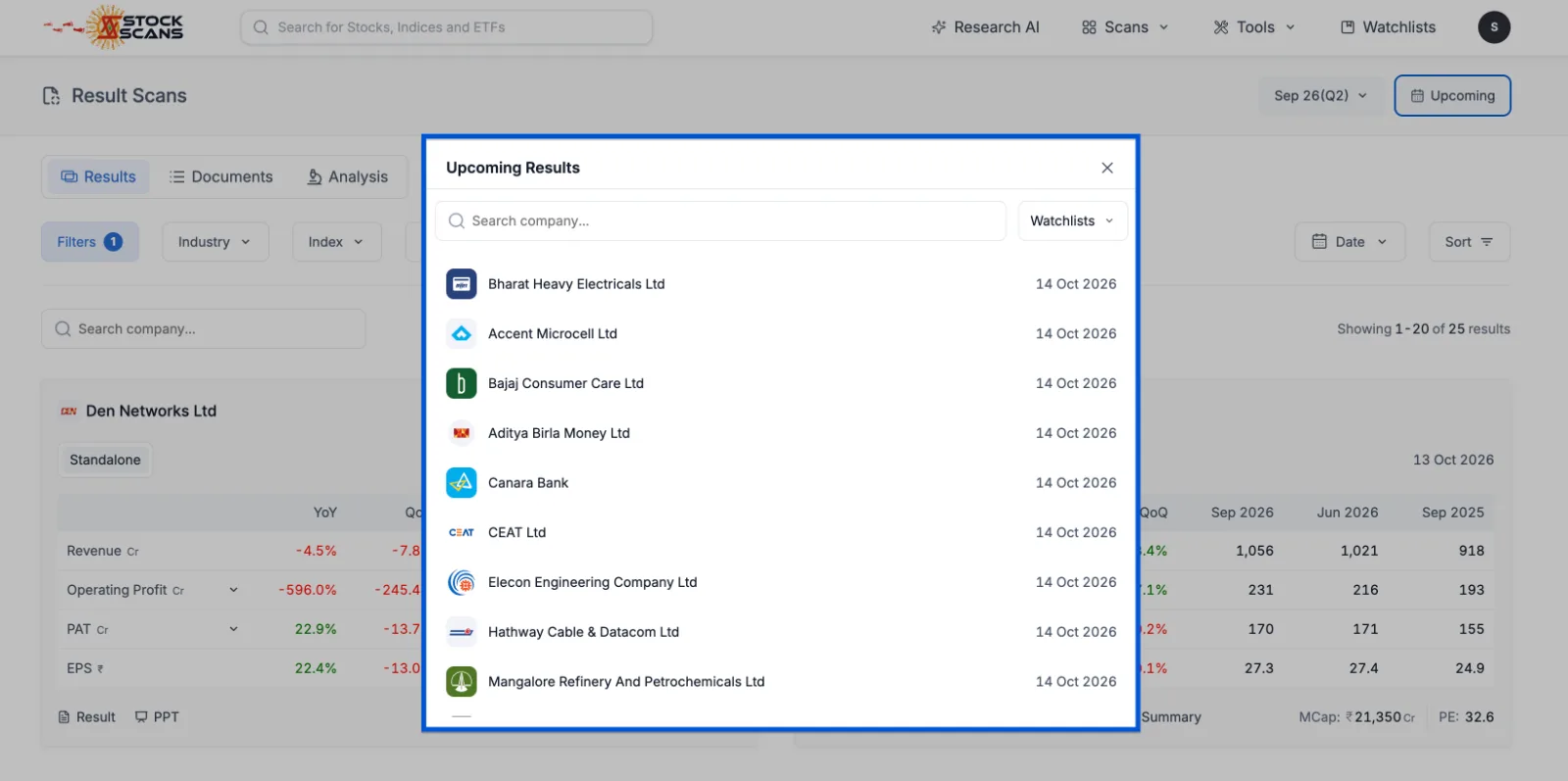
Some interesting results and concalls are scheduled for tomorrow. You can track upcoming earnings announcements through Result Scans and follow management commentary through Concall Scans.
A thought from the Bhagavad Gita
तद्विद्धि प्रणिपातेन परिप्रश्नेन सेवया। ~ B.G 4.34
Seek knowledge through humility, sincere questioning and service.

In Investing perspective: Good research begins with asking questions. Rather than accepting management commentary at face value, investors should question assumptions, examine the numbers and keep learning.
See you tomorrow.
Amit
Disc: Not a Buy/Sell Recommendations.
Comments