
The half of the market nobody can search
Everything a listed company tells you arrives in one of two forms.
There are the numbers. Revenue, margin, debt, promoter holding. These are tidy, they sit in columns, and a scan can sort every company in the market by any of them in about a second.
Then there is everything else, and it is nearly all words. The reason behind the number is always in the words. A margin fell. The results tell you that. Why it fell, whether it comes back, and what management intends to do about it is in the earnings call, the presentation and the annual report, in sentences.
That text is enormous. One company publishes a few hundred pages a year. The market publishes a library.
The problem with words
Numbers can be filtered. Words cannot.
Ask a screener for every company with return on capital above fifteen percent and it answers instantly. Ask it which companies said their raw material costs have peaked and it has nothing to offer, because that sentence lives in a transcript and no column holds it.
So the questions that matter most are the ones nobody can look up. Which managements are worried about the same thing this quarter. Who is quietly walking back a promise they made a year ago. Which companies keep naming a customer or a technology that has not shown up in anyone's numbers yet.
The only honest way to answer any of those is to read everything, and nobody reads everything. People read one company at a time, slowly, and find out about the pattern months later when somebody writes it up.
Asking in plain English
Open Research AI in the top menu. There is one box. Type your question the way you would say it to a colleague who had read it all.
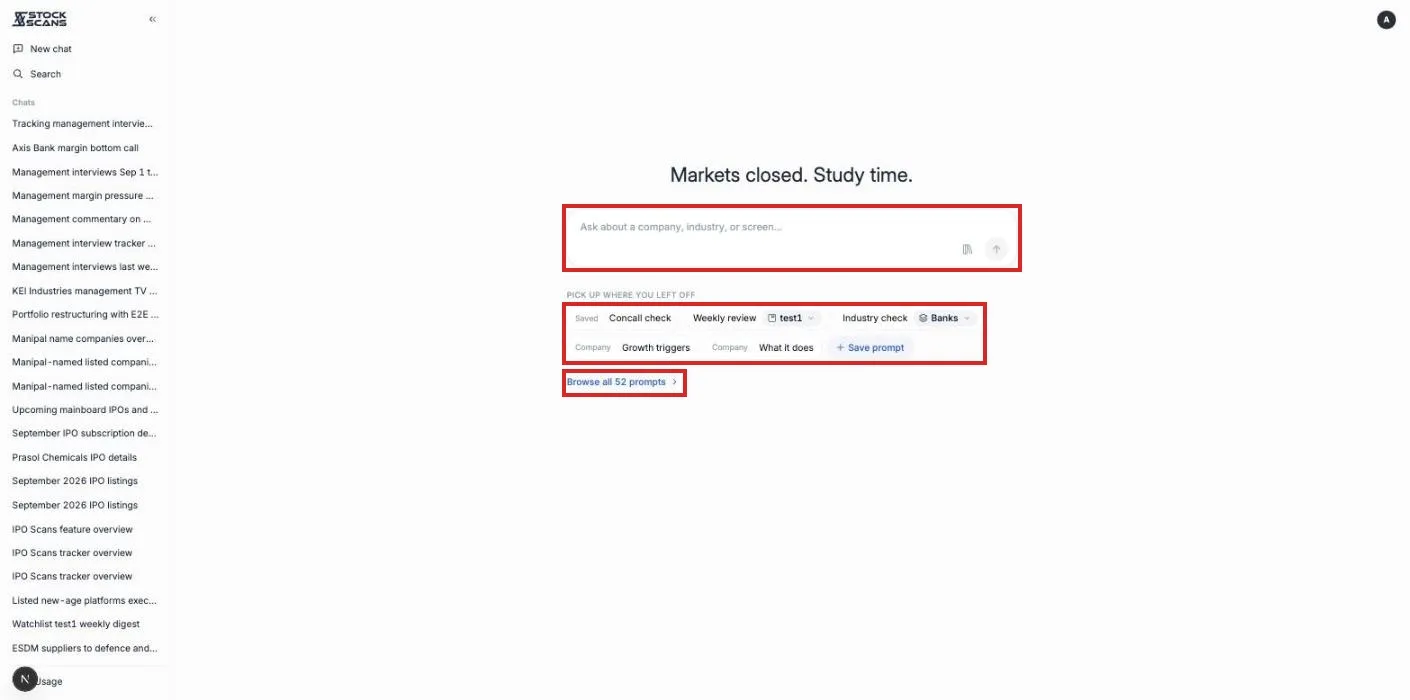
Start with one company you know:
"What does Titan actually do, and where does the profit come from?"
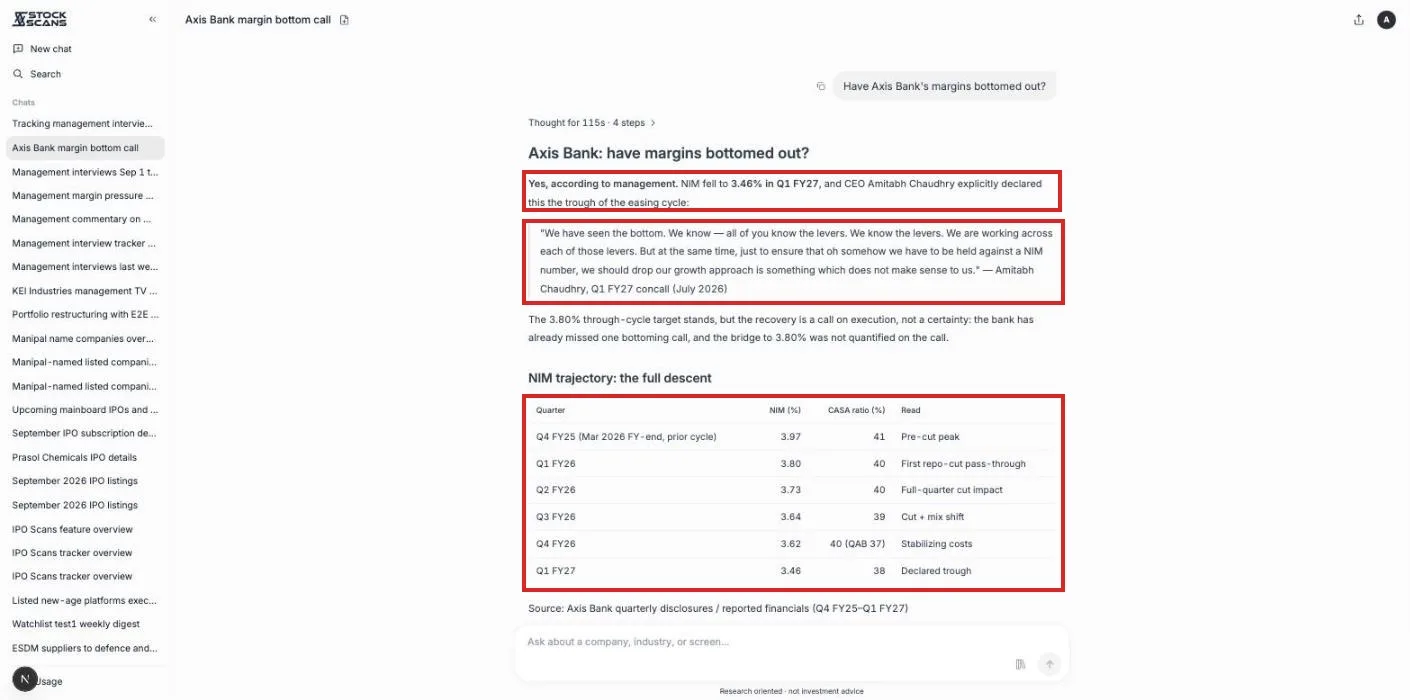
"Have Axis Bank's margins bottomed out?"
"What did Bajaj Finance guide for credit costs, and what did they deliver?"
A vague question gets a vague answer, and that is usually your fault rather than its. "Tell me about HDFC Bank" returns an encyclopedia entry. "Why has HDFC Bank's loan growth slowed since the merger?" returns the thing you wanted.
One question, the whole market
This is the part with no equivalent anywhere else. You can ask something that no single company can answer, and it will go and read across the market to build the answer.
Take a real one. Which electronics manufacturers supply the aerospace, defence and automotive industries?
There is no screen for that. It is not a number sitting in a column. It is a fact scattered through the annual reports and earnings calls of a few dozen companies, most of which you would have to already know about in order to go looking for them.
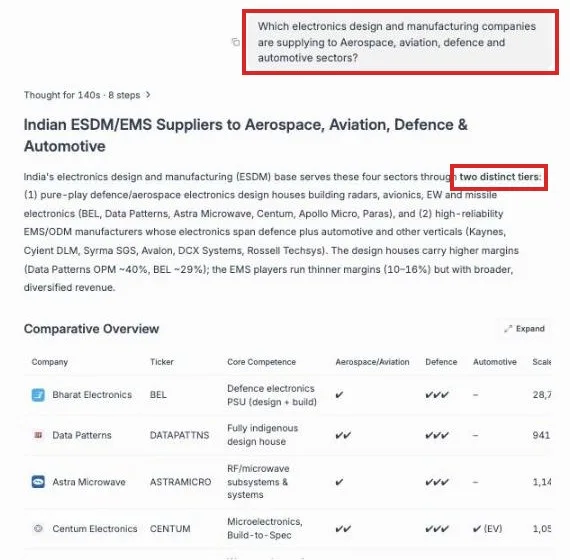
The answer does not just return names. It works out that this industry has two layers, and sorts the companies into them. On one side the pure-play design houses building radars, avionics and missile electronics. On the other the high-reliability manufacturers whose lines run defence alongside automotive. It then notes that the first group earns much fatter margins and the second has broader, steadier revenue.
That structure is the actual insight. The list of names is what falls out of it.
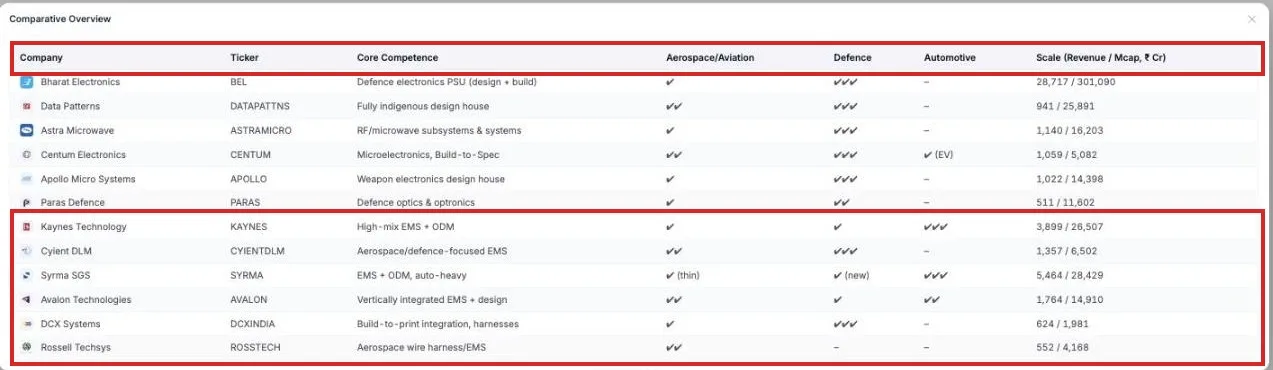
Twelve companies, checked off against each end market, with revenue and market value beside them. Assembling that by hand is a week of reading, and you would still be unsure you had not missed someone.
The same shape of question works on anything running through the market at once:
"Which companies said on their last call that raw material costs have peaked?"
"Who is guiding for margin expansion next year, and who is warning about pressure?"
"Which listed companies mentioned data-centre demand last quarter, and what did they say?"
A theme is obvious the moment four managements have named it, and invisible while it sits in four separate transcripts. That gap is where this earns its keep. The prompt library keeps a whole set of these under Discover.
It is the same move as a scan, applied to sentences instead of columns.
What comes back
An answer opens with the verdict in one line, then the evidence for it.
Numbers across quarters or companies arrive as a table, so you are comparing rather than reading. Where management said something that matters, it is quoted in their own words, with the call it came from.
Under the answer sit two or three related questions. Click one and it runs, remembering the companies you were already discussing. The second question is usually the better one, because by then you know what you did not know.
Checking it
Any program that writes fluent English about your money can be confidently wrong, so nothing here asks you to take its word.
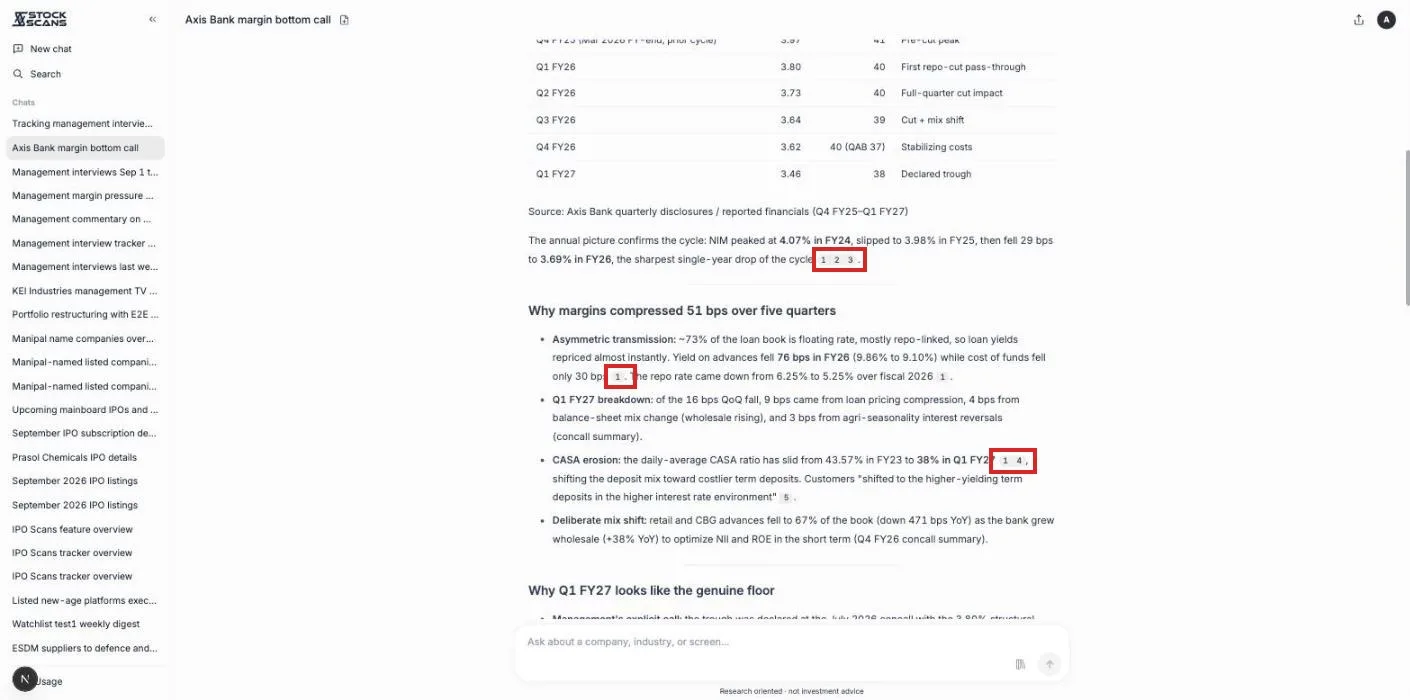
Every figure carries a small bracketed number. Click it and the source opens beside the chat, at the exact page, with the sentence highlighted. A quote opens the transcript. A remark from a television interview opens the video at that moment.
The line above every answer, "Thought for 140s, 8 steps", opens to show which documents it went out and read before writing a word.
It reads only what StockScans holds, which means filings, transcripts, presentations, annual reports, interviews and the financial data behind the scans. It does not browse the internet, so it cannot pass on a rumour. It also will not tell you whether to buy.
Check a couple of citations the first few times. If a number ever turns up without one, treat it as a claim rather than a fact.
When you do not know what to ask
Knowing what to ask about a company is most of the skill, and it is the part nobody teaches you. A blank box is its own kind of problem.
Press the library icon in the box, or type / into the empty box.
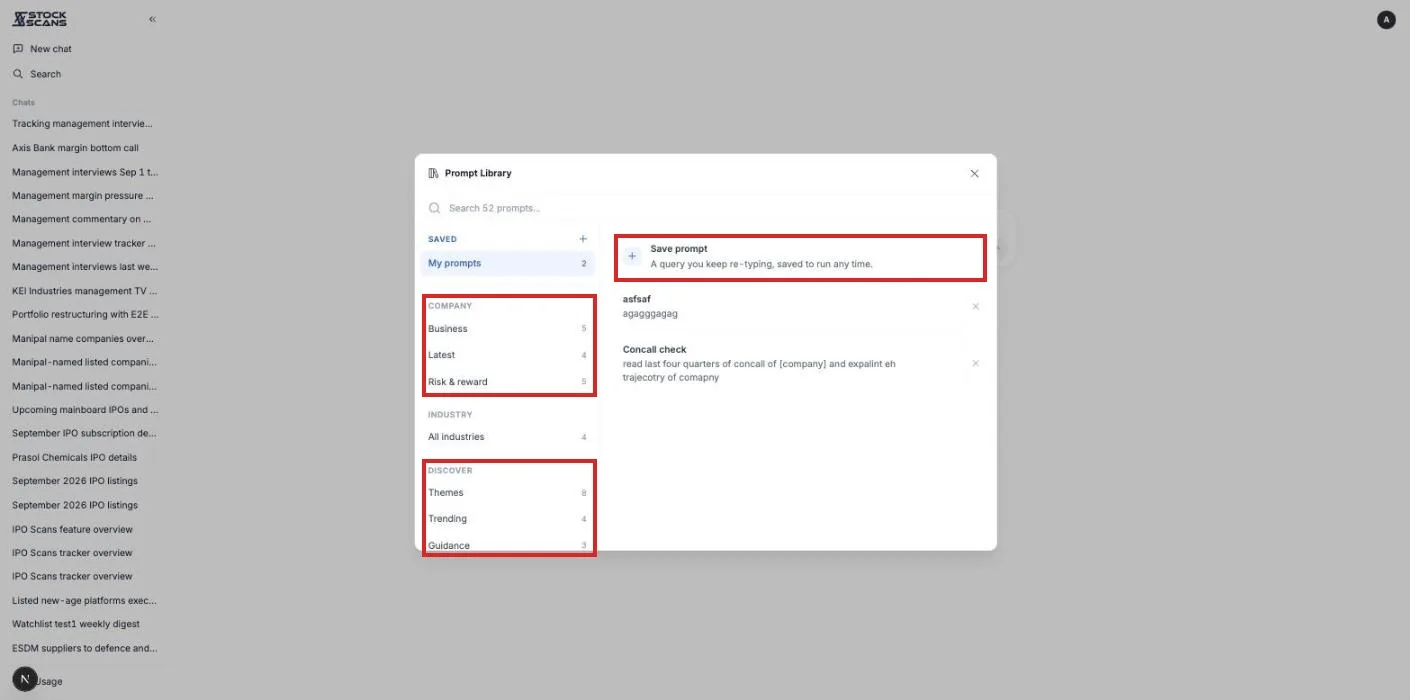
About fifty questions, sorted by what you are trying to work out. Company holds the three that matter for one business: what it is, what is new, and what you risk against what you might make. Industry rewrites the same question for each of seventeen sectors, so "what drives margins here" asks about the right things for a bank and for a cement company, which are not remotely the same things. Watchlist runs one question across your own list.
Picking one does not send it. It lands in the box with the company name waiting to be replaced, so you read the question before you ask it.
A question you keep retyping can be saved under My prompts. Write [company] where the name goes and it becomes your own template for any stock.
Keeping what you find
Research you cannot find again was not worth doing.
Under every answer are four buttons. Notes files it as a dated entry in that company's notes, so months of thinking about one business collect in one place instead of scattering across a chat history. Watchlist and Custom index take the companies the answer named and add them. Alert sets one on them.
The download icon saves the conversation as a PDF with citations intact. The share icon makes a read-only link you can send on and revoke later. Every conversation stays in the sidebar, and Search reads their contents, not just their titles.
What is free
Ten questions. Ten in total, not ten a month, with a free account. Enough to learn whether this changes how you work.
Everything around them. The prompt library, saved prompts, notes, PDF export, sharing and full history, at no cost.
Premium comes with a monthly research allowance that resets each month, and Premium Plus carries five times as much. It is an allowance rather than a question count because a question that spans forty companies costs far more to answer than a one-line lookup, and calling both of those "one question" would be the dishonest way to do it. You see what is left as a percentage.
Three questions to ask today
One company you hold. "What did management commit to on the last three calls, and which of those have they delivered?"
One company you are considering. "What are the three biggest risks in the latest annual report, in management's own words?"
One thing you have been wondering about the market. Not a company, the thing itself. Which managements are talking about it, and what are they saying. That is the question you could never ask before.
The filings did not get shorter. The reading did.
Comments