

StockScans Daily: What the Market Is Telling Us This Week
Result season has just started, and we are already on Day 6 of writing StockScans Daily.
The idea is simple: read more, track businesses closely, and spend time on things that actually matter to investors. Not every announcement is important, not every result tells the complete story, and not every market move deserves a reaction.
Today, we will look at three things:
Where the market stands right now, using index breadth and stock-level data.
What this week’s major order wins tell us about business activity.
Which companies are scheduled to hold their concalls tomorrow, October 12.
But before we get into the numbers, I want to share something I was re-reading in the Bhagavad Gita this week.
1. A thought from the Bhagavad Gita
There is one question Arjuna asks Krishna that I have always loved.
Bhagavad Gita 2.54
arjuna uvācha
sthita-prajñasya kā bhāṣhā samādhi-sthasya keśhava
sthita-dhīḥ kiṁ prabhāṣheta kim āsīta vrajeta kim
Arjuna said:
“O Keshav, what is the disposition of one who is situated in divine consciousness? How does an enlightened person talk? How does he sit? How does he walk?”
Arjuna wants to understand what a person with steady wisdom actually looks like in everyday life.
In the verses that follow, Krishna explains this state of mind. One verse that particularly stands out to me is:
duḥkheṣhv-anudvigna-manāḥ sukheṣhu vigata-spṛihaḥ
vīta-rāga-bhaya-krodhaḥ sthita-dhīr munir uchyate
“One whose mind remains undisturbed amidst misery, who does not crave for pleasure, and who is free from attachment, fear, and anger, is called a sage of steady wisdom.”
Three words here are worth sitting with: attachment, fear and anger.

Think about how often these three emotions influence our decisions in the stock market.
When a stock goes up, we become attached to the idea that it will keep going up. When it falls, we become afraid of losing more money. And when the market does something unexpected, we become frustrated and start looking for someone or something to blame.
Sometimes, we stop looking at the business altogether. Our emotions take over the decision.
This is why I think the idea of steady wisdom is so relevant to investing. It does not mean that we stop feeling emotions. It means we learn not to let every emotion dictate our next action.
The market will keep moving. That is what markets do.
Our job is to keep reading, scanning, tracking businesses and improving the quality of our decisions.
As James Clear writes in Atomic Habits, small improvements compound over time. We do not need to become perfect investors overnight. We can try to become 1% better every day.
Read one more concall. Understand one more business. Check one more assumption. Learn to sit with uncertainty instead of reacting to it.
The goal is not to predict every market move. It is to build a process that helps us think clearly through different market conditions.
With that thought, let’s get into today's scan.
2. Market breadth: What is happening beneath the indices?
One thing I keep coming back to is that an index can tell us where the market is, but breadth helps us understand how many stocks are participating in that move.
For today's exercise, we looked at two things across major Nifty indices:
The percentage of stocks trading above their 200-day EMA.
The percentage of stocks trading more than 30% below their 52-week highs.
The first gives us a sense of long-term trend participation. The second helps identify where individual stocks have experienced deeper drawdowns.
Here are a few observations from our StockScans Research AI screen dated October 11.
Large caps are showing considerable weakness
Only 5 out of 50 Nifty 50 stocks, or 10%, are trading above their 200-day EMA.
The number is equally worth watching in the broader large-cap universe:
Nifty 100: 21% above the 200-day EMA.
Nifty 200: 24.5%.
Nifty 500: 32.2%.
Nifty Total Market: 36.4%.
This tells us that long-term trend participation is weak, particularly among the largest companies.
An index's performance alone may not tell us how widespread the underlying strength or weakness is. Looking at individual constituents gives us another layer of information.
Smaller stocks are showing better trend participation, but there is a catch
The numbers look different as we move down the market-cap curve.
Nifty Smallcap 50: 58% above the 200-day EMA.
Nifty Smallcap 100: 50%.
Nifty Microcap 250: 44.8%.
Nifty Smallcap 250: 40.4%.
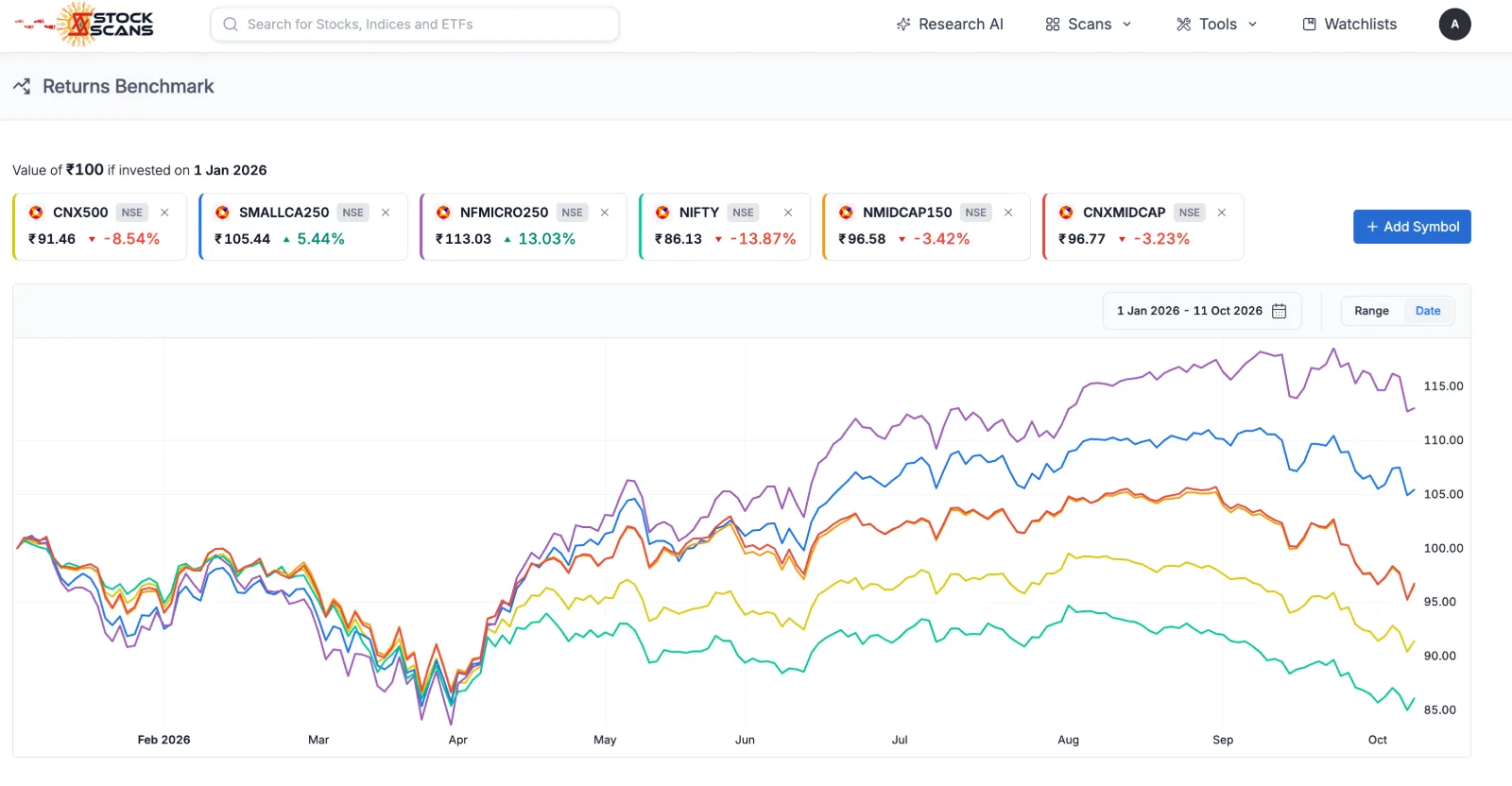
At first glance, this looks much stronger than the Nifty 50.
But there is another side to the data.
32.8% of stocks in both the Nifty Smallcap 250 and Nifty Microcap 250 are more than 30% below their 52-week highs.
So, stronger trend participation at the index level does not mean every stock is doing well. There can be considerable divergence between individual businesses.
This is precisely why I prefer looking at the market through multiple lenses instead of relying on a single index chart.
3. Order book watch: More than ₹18,000 crore in weekly opportunities
Moving from market trends to business activity, this week's order announcements provide plenty of material to track.
Our StockScans Research AI review of October 4–11 identified more than 40 listed companies filing fresh order, contract-signing or award-related announcements.
The individually disclosed values total approximately ₹11,100 crore. The broader tally exceeds ₹18,000 crore when Larsen & Toubro's two value-undisclosed wins and Dilip Buildcon's approximately ₹1,800 crore pipeline EPC opportunity are included.
The major developments
1. Power transmission and engineering
Larsen & Toubro announced a “Mega” power transmission win covering projects in Saudi Arabia, the UAE and India. It also received a “Major” award related to a 2 × 800 MW thermal power plant at Chandrapura, Jharkhand. The values of these awards were not disclosed.
KEC International announced two sets of orders totalling ₹2,044 crore across power transmission and distribution, cables, wind EPC and related works.
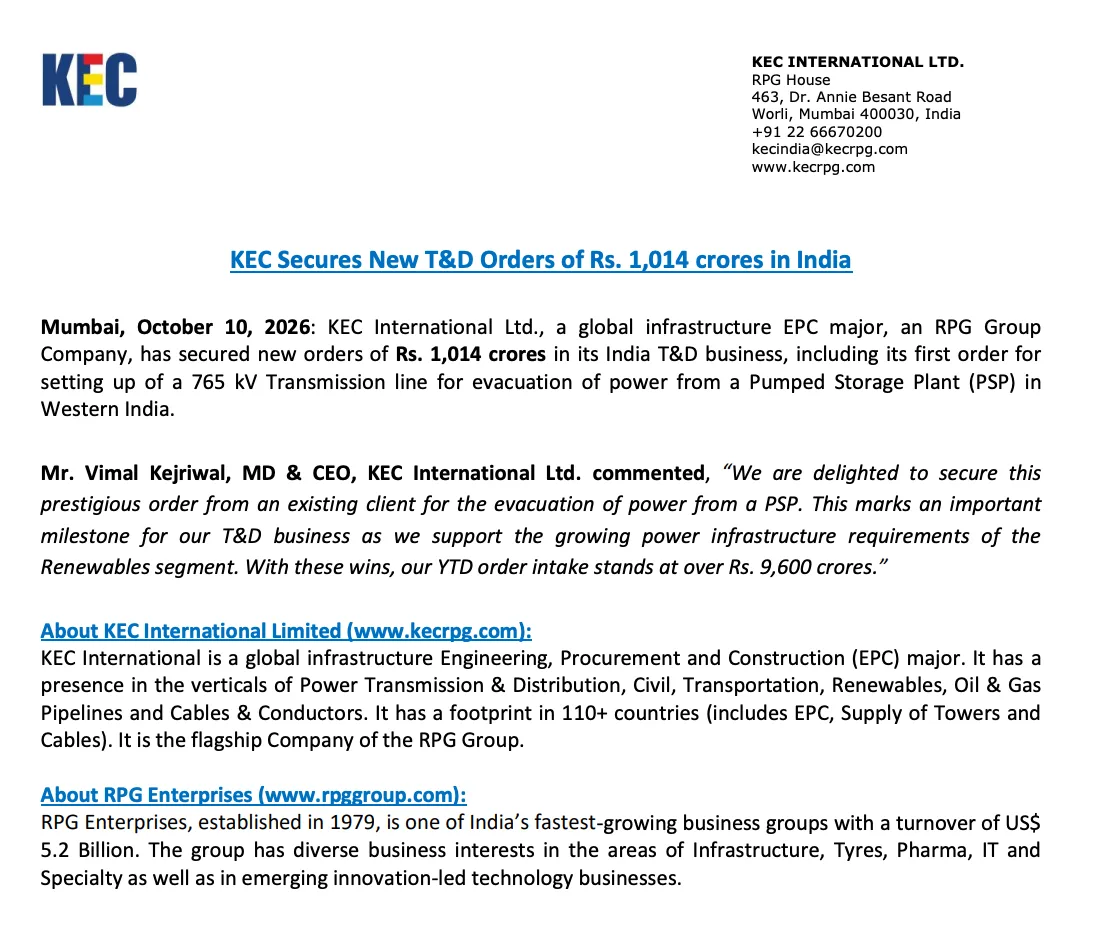
The October 10 announcement also marked KEC's first 765 kV transmission line order for power evacuation from a pumped-storage project.
For investors tracking the power infrastructure theme, the useful questions are about execution timelines, margins, working capital and the pace at which these orders convert into revenue.
2. Solar and renewable energy
Premier Energies reported an order intake of ₹4,001 crore for July–September, covering 2,308 MW of solar cell and module supply and EPC business, excluding its retail segment.
Bondada Engineering announced a ₹1,153.93 crore solar EPC order covering 270 MWp across multiple sites in Maharashtra. Its disclosure identifies the contract as a related-party transaction, making the relationship and execution details important to review.
There were also fresh solar-pump opportunities:
Shakti Pumps: ₹112.18 crore for the empanelment of 4,755 solar pumps.
Saatvik Green Energy: approximately ₹100 crore for 5,000 solar PV water pumps.
Both announcements relate to MSEDCL schemes, with execution timelines of 60 days from the relevant work-order or commencement milestone.
For this group, I would track not just fresh order intake, but also capacity utilisation, execution speed, receivables and cash conversion.
3. Roads, urban infrastructure and industrial projects
NCC secured a ₹1,286.03 crore order, excluding GST, for a road project in Telangana, with an 18-month execution period.
SEPC formalised a ₹854.57 crore contract, net of the specified input tax credit, for the pellet plant package at SAIL-IISCO Steel Plant in Burnpur. The project forms part of the plant's expansion programme and carries a 32-month execution timeline.
Dilip Buildcon also disclosed an approximately ₹1,800 crore EPC opportunity relating to the Paradip–Raipur LPG pipeline. This should be assessed separately from confirmed contract awards.
What I would track next
Large order announcements can be exciting, but the announcement itself is only the beginning of the story.
For every order-book business, I would keep coming back to five questions:
How large is the order relative to the company's existing order book and annual revenue?
What is the execution period, and how much revenue could be recognised over that period?
Are the expected margins attractive?
Will the project consume significant working capital?
Is the order translating into actual revenue and cash flow?
An order book creates visibility, but execution determines how much value eventually reaches shareholders.
That is why these announcements are worth tracking beyond the headline number.
4. Tomorrow's concall calendar: October 12, 2026
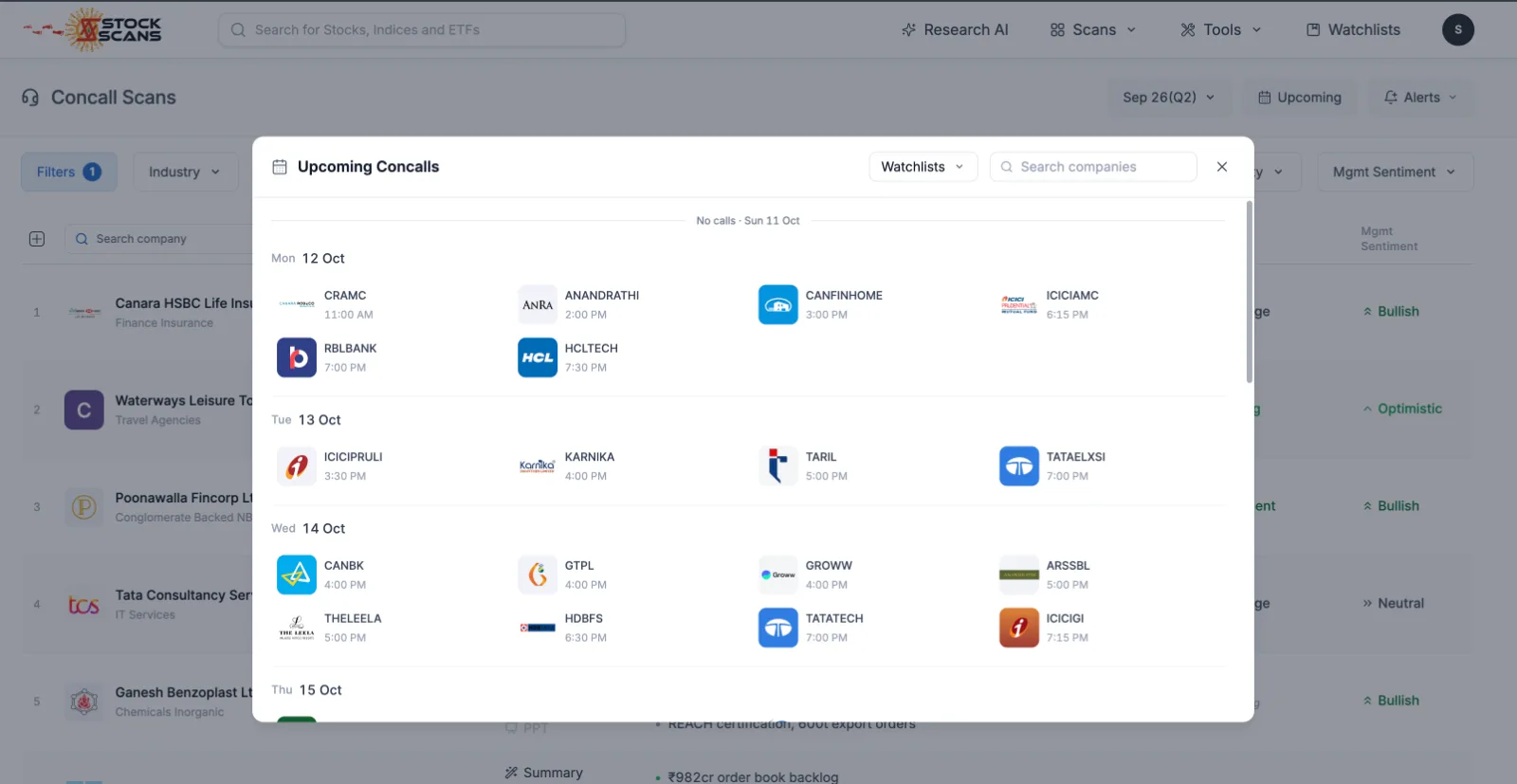
Canara Robeco AMC and ICICI Prudential AMC
Track assets under management, equity and debt mix, net flows, market-share trends and operating profitability. For asset managers, it is useful to distinguish market-led AUM growth from genuine net inflows.
Anand Rathi Wealth
Look at net new money, client acquisition, the growth of relationship managers, revenue per client and operating margins. The quality and sustainability of client inflows matter as much as the headline growth rate.
Can Fin Homes
Focus on loan growth, disbursements, borrowing costs, spreads, asset quality and collection efficiency. The relationship between growth and funding costs will be particularly important to understand.
RBL Bank
Pay attention to deposit growth relative to advances, the cost of deposits, net interest margin, slippages, credit costs and the direction of asset quality. Growth is useful, but the quality of that growth matters just as much.
HCL Technologies
Listen for commentary on revenue growth, deal wins, conversion of the order pipeline, margins, client spending and the demand outlook across business segments. Management's commentary on demand and guidance will be worth comparing with the reported numbers.
These are the areas I would prepare to investigate, rather than assumptions about what management will say.
A useful exercise is to write down three questions before each concall and revisit them afterwards. It helps us separate what management actually communicated from what we expected to hear.
5. What's new on StockScans?
We have been working on making StockScans a more useful part of your daily investing process.
Recently, we upgraded MarketScans, and we have also added a dedicated What's New section on StockScans.
Detailed Weekly Video: https://youtu.be/EYsp-x5Clx4?si=tXn1bfG4CXkI6Ty1
The idea is simple: you shouldn't have to search around to figure out what's been added to the platform. From new features and upgrades to product improvements, you now have one place to keep track of what's new.
Explore What's New on StockScans: https://www.stockscans.in/whats-new
And if you've been thinking about subscribing to StockScans or renewing your membership, our Navratri festive offers are available too.
Explore subscription plans and festive offers: https://www.stockscans.in/pricing
We cannot control every market move, every quarterly result or every management commentary. We can control how carefully we prepare, how honestly we assess the evidence and how we respond when the facts change.
Let's keep doing the work, one day at a time.
One more scan. One more concall. One better question. A little better every day.
See you tomorrow.
Amit
Disc: Not a Buy/Sell Recommendations.
Comments