
What I Learnt From Listening to Management Interviews Today
October 7, 2026 | StockScans Daily Management Interview Series
Every day, companies talk.
About growth.
About demand.
About margins.
About the industry.
But somewhere inside those interviews, there are usually a few sentences that are actually worth remembering.
This series is about finding those sentences.
1. A 25 bps rate hike may not matter as much as we think
The banking commentary today was interesting.
At SBI, management believes credit growth could moderate from around 18–19% to 16–17% over the next six months, but demand remains broad-based across agriculture, MSMEs and retail.
Rana Ashutosh Kumar Singh, Deputy MD at SBI, called the impact of the 25 bps rate hike “a very marginal increase.”
The important part for me wasn't the rate hike.
It was the underlying message:
When demand is strong, a small change in the cost of money doesn't necessarily stop businesses from borrowing.
But there is another thing I would watch closely.
Deposits are still lagging credit growth.
And for a bank, that can eventually become more important than the headline rate itself.
My takeaway:
Don't just track credit growth.
Track how that credit growth is being funded.
Detailed Interview: https://www.youtube.com/watch?v=knQ6awL9Zk0
2. Festive demand is healthy. But calendars can distort the numbers.
Two very different businesses gave me a similar lesson today.
Muthoot Microfin continues to see festive demand supporting credit growth, with management pointing to comfortable system liquidity.
At V-Mart, demand was described as “steady and robust.”
But the shift in the Pujo calendar could create some pressure on Q2 margins.
This is something I think investors often underestimate during results season.
A weak quarter doesn't always mean a weak business.
Sometimes the calendar moves.
Festivals move.
Shipments move.
Revenue moves with them.
So before changing a thesis because of one quarter, I want to understand whether the weakness is structural or simply timing.
My takeaway:
Always look at the business across two quarters before judging the trend.
Detailed Interview: https://www.youtube.com/watch?v=COCetJwvNSU
3. An order win is only the beginning of the story
Transrail Lighting caught my attention today.
The company has won a ₹400 crore HTLS reconductoring order, while the broader near-term opportunity cited in the interview was around ₹2,000 crore.
Easy headline:
₹400 crore order win.
But that's not enough - What matters next is:
When will it execute?
At what margin?
How quickly can the order book convert into revenue?
How much of the larger opportunity can it capture?
The available interview excerpt doesn't give us management's answers on the execution timeline, margins or FY27 guidance.
And that's precisely why I don't want to jump from:
Order win → earnings upgrade → stock rerating.
There are several steps in between.
My takeaway:
An order book tells you about opportunity.
Execution tells you about the business.
Detailed Interview: https://www.youtube.com/watch?v=FOP7FpFxvJs

4. Commodity prices can quietly change the entire P&L
The V-Mart and Patanjali Foods interviews were interesting when viewed together.
V-Mart is seeing pressure from raw material costs.
Patanjali Foods, meanwhile, is watching global edible oil prices, crude and the impact of import-duty changes. Management said the recent duty change did not have a major price impact.
Different businesses.
Different commodities.
Same investing lesson:
Margins don't exist in isolation.
Sometimes you have to go one step backward.
Crude → edible oil prices → input costs → pricing → margins.
Or:
Raw material → product prices → consumer demand → gross margin.
This is where management interviews become useful.
They help you understand which external variables management is actually watching.
While going through today's management interviews, I also spent time on a few recent earnings calls on Concall Scans.
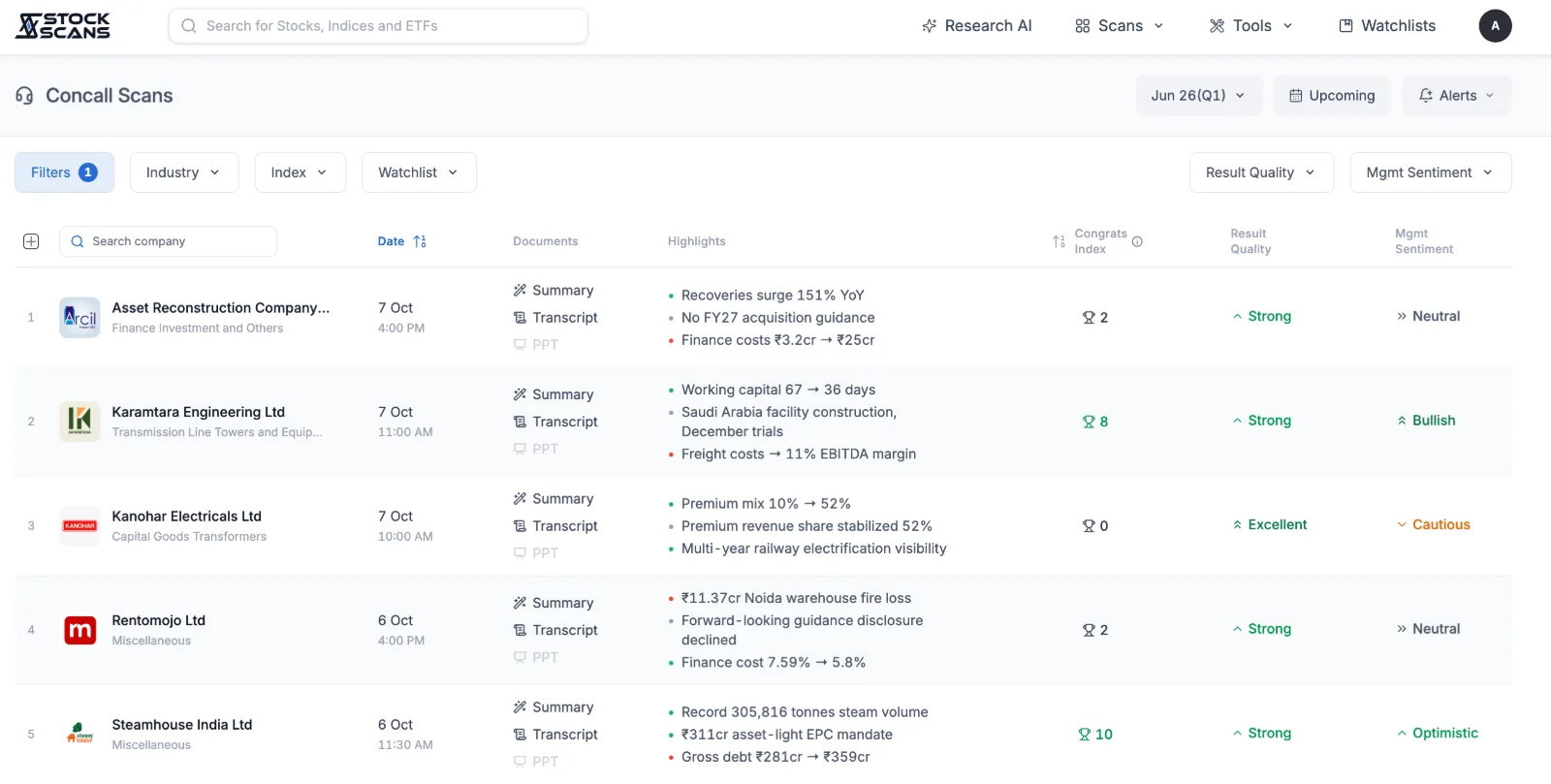
Karamtara Engineering: the tariff story is less scary than it looks
Karamtara reported 72% YoY revenue growth to ₹1,581 crore, but EBITDA margin came in around 11% versus 13% a year ago, largely because of elevated freight and trucking costs.
The interesting part?
The company had ₹250 crore of US Section 232 tariff costs in the quarter, but management says the entire cost was passed on to customers.
So the tariff number looks huge on the P&L.
But it isn't necessarily an economic hit to the business.
What I found more interesting was the operational side:
Working-capital days came down from 67 → 43, with management targeting 36 days.
And management expects Q2 margins to be “far better” as revenue scales and fixed assets get better utilised.
What I'm tracking:
Can revenue growth + better asset utilisation + freight normalisation take margins back toward the earlier ~13% level?
That's a much more interesting question than simply asking whether tariffs are good or bad.

Kanohar Electricals: watch the mix, not just the growth
One number jumped out from the Kanohar call.
Premium products now contribute ~52% of revenue.
That number was only 10.3% in FY24. It moved to 52% in FY25 and has remained around that level in Q1 FY27.
That's important.
Because sometimes the real change in a business isn't visible in topline growth.
It is hidden inside the mix.
A sustained shift towards higher-value products can change the economics of a business even before the market fully appreciates it.
Management attributes the premiumisation to railway electrification and infrastructure demand.
What I'm tracking:
Does the ~52% premium mix sustain?
If yes, this becomes much more interesting than simply tracking revenue growth.
Glass Wall Systems: the quarter looks weaker than the underlying business
This was probably one of my favourite reads.
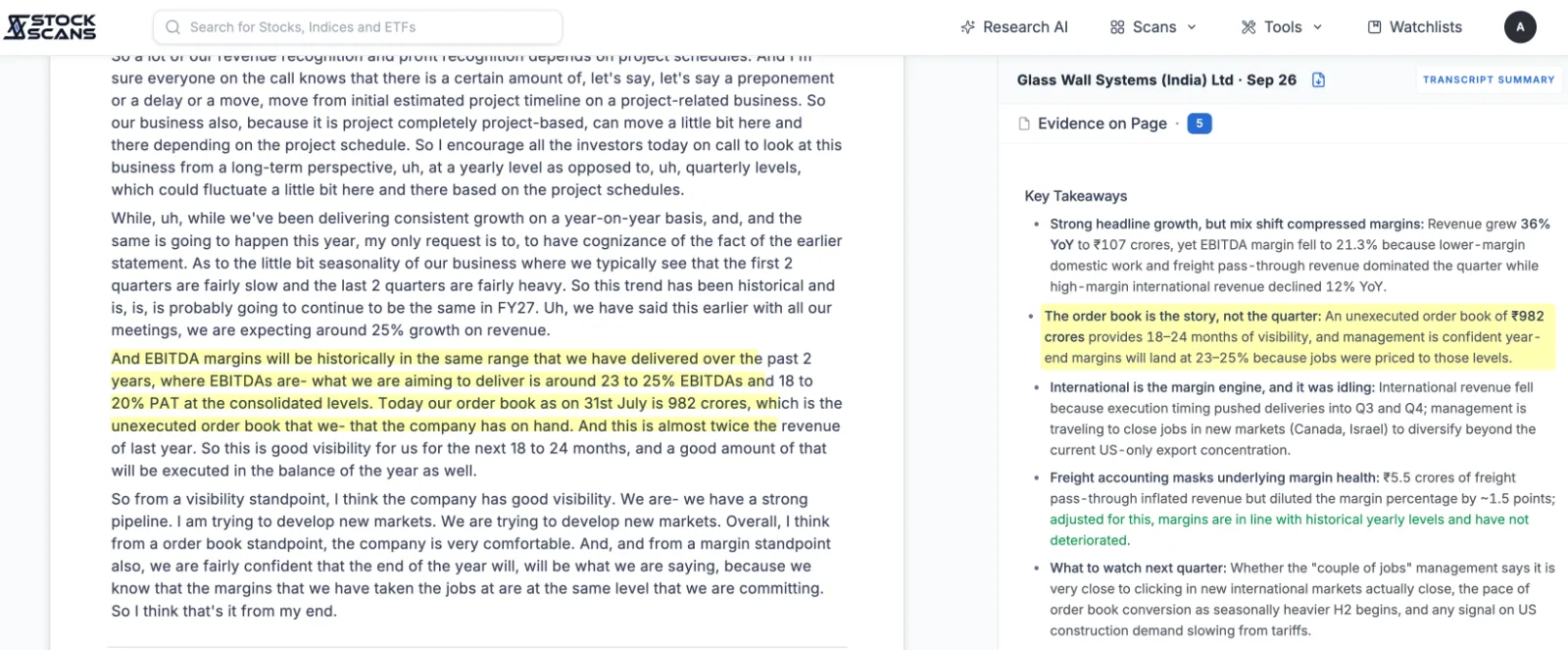
Revenue grew 36% YoY to ₹107 crore, but EBITDA margin fell to 21.3%. At first glance, that doesn't look particularly exciting.
But dig a little deeper.
International revenue declined 12% because of execution timing, while domestic revenue grew 93% and fenestration grew 127%.
Then comes the really interesting part.
The company had ₹5.5 crore of freight pass-through revenue which carried no margin and diluted the reported margin by roughly 1.5 percentage points. Adjusting for that, the underlying margin picture was much healthier.
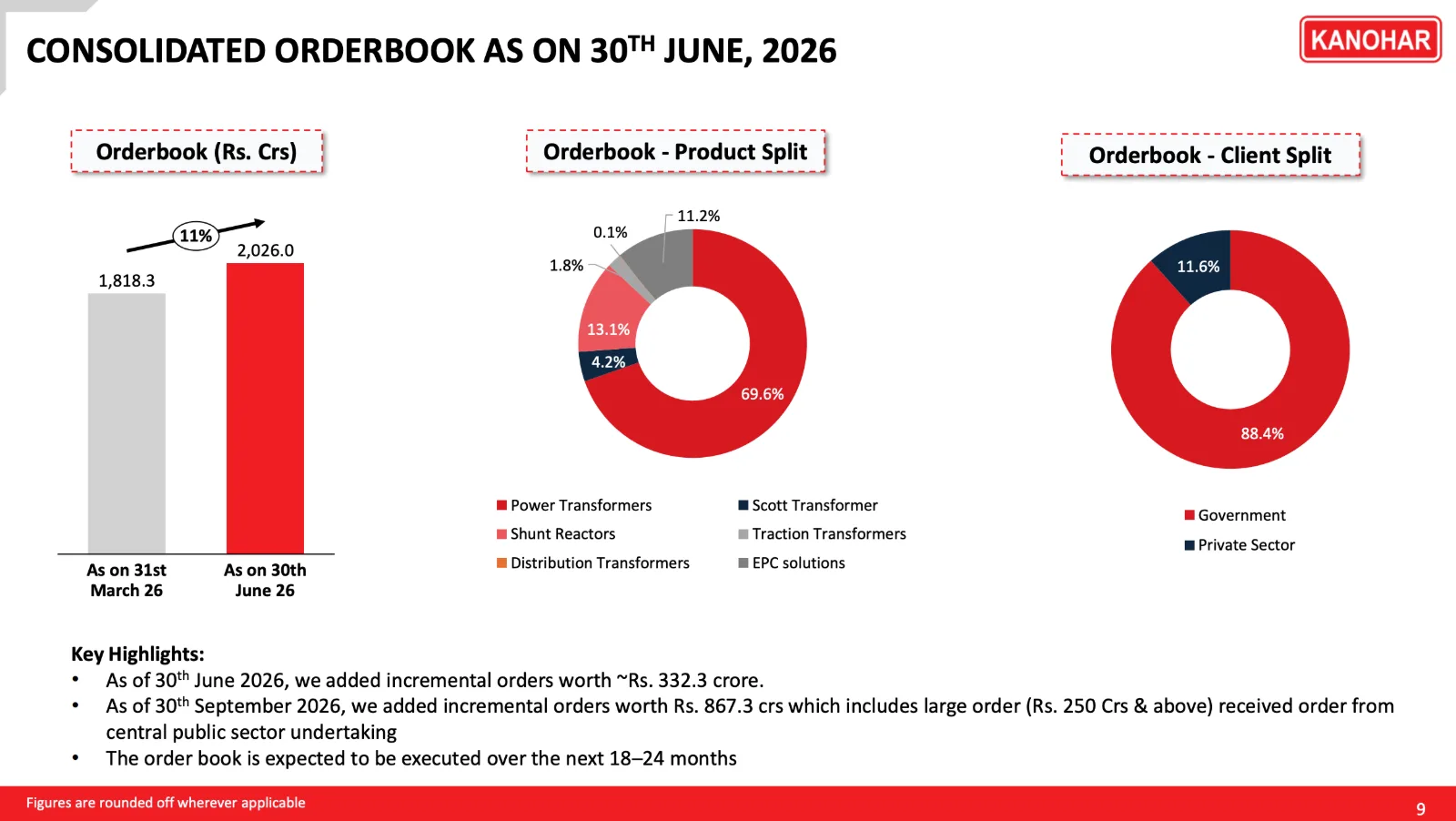
And the company is sitting on an ₹982 crore unexecuted order book, providing roughly 18–24 months of visibility.
Management is still targeting 23–25% EBITDA margin for FY27.
This is exactly why I like reading concalls.
The headline number tells you the quarter.
The call helps you understand why the number happened.
What I'm tracking:
International execution, order-book conversion and whether margins move toward the 23–25% target.
A thought from the Bhagavad Gita
There is a line from the Gita that I think fits this process beautifully:
“योगः कर्मसु कौशलम्”
Yoga is excellence in action.
- Bhagavad Gita 2.50.
For an investor, I interpret it simply:
Do the work.
Do it well.
Keep sharpening the craft.
Read the numbers.
Listen to management.
Question the narrative.
Connect the dots.
And do it again tomorrow.
Because the edge rarely comes from one great insight.
It compounds through the work you keep doing.
See you tomorrow.
Amit
Disc: Not a Buy/Sell Recommendations.
#StockScans
Comments