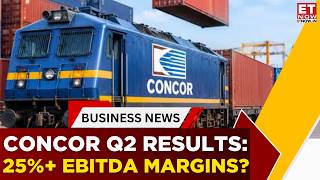
- Container Corporation of India (CONCOR) is India’s dominant rail-container logistics company - essentially a toll bridge on the country’s freight corridors, moving cargo in steel boxes on trains between ports and factories across a network of 66 ICDs/CFSs/Strategic Tie-ups. It was born in 1989 when the government carved out seven Inland Container Depots from Indian Railways to create a dedicated container-transport ecosystem, and it has remained a listed public-sector enterprise with the Ministry of Railways holding just under 55%. The recurring approach is simple: own the terminal, own the rakes, own the containers, and earn a margin on every box moved - then use that infrastructure to layer on higher-value services like warehousing, first-mile trucking, and now even ocean shipping.
Business segments
Three engines at different stages - a rail-container cash cow that moves over 90% of its cargo by train, a fast-scaling bulk-cement business built on the same tracks, and an early-stage international shipping arm that puts CONCOR’s own containers on vessels to the Middle East and Far East.
1. Rail-based container logistics: the backbone that moves India’s factory output
CONCOR runs the country’s largest container-train network, collecting a freight margin on every box while competing against roads, not other rail operators.
- Paid per box, benchmarked to road - the company earns a spread between the haulage charges it pays Indian Railways and the freight rate it charges customers, pricing its service against what a truck would cost because its rail-based offering is fundamentally different from other train operators. When Indian Railways withdrew a 25% haulage discount, CONCOR passed the full increase through to customers, showing the pricing power that comes from being the lower-cost alternative to road.
- The terminal network is the moat - with 80 ICDs and 20 CFSs spread across India, CONCOR has roughly four times the inland terminal footprint of its nearest rail competitor, which operates only 20-25 depots. That density means a factory in Mandalgarh shipping cement or a coffee grower near Mysuru can reach a CONCOR terminal without building a rail siding of their own.
- Double-stack trains change the economics - running containers two-high on 6,396 double-stack rakes cuts the cost per box, and CONCOR shares those savings with customers to pull freight off highways. The imminent connection of the Dedicated Freight Corridor to JNPT, India’s largest container port, will let double-stack trains reach the quayside for the first time, which management expects to lift the port’s rail share from 15% toward 19%.
- EXIM dominates, but domestic is the growth lever - about three-quarters of rail-container volume is export-import cargo, where CONCOR holds a 73% market share among rail operators, while domestic accounts for the remaining quarter at a 30% share. The real prize is the 80% of India’s containerized freight that still moves by road; every percentage point that shifts to rail expands the addressable market.
- Services wrap around the box - beyond the train movement, CONCOR runs customs clearance, warehousing across 4.5 million square feet, and a growing first-mile-last-mile trucking fleet of 230 LNG trucks and electric vehicles, aiming to handle 80% of its throughput on its own wheels. That turns a pure rail play into an end-to-end logistics provider that keeps more of the customer’s spend.
2. Bulk cement in tank containers: the same tracks, a new cargo
CONCOR is building a dedicated bulk-cement rail business using specialized tank containers, with contracts already signed with India’s two largest cement makers.
- A portable unloading system unlocks the market - the company developed dust-free equipment that can empty 27-31 tonnes of cement from a container into a silo in under an hour and can be set up at any location within three to four weeks, removing the need for fixed infrastructure at the customer’s site.
- Anchor customers de-risk the ramp-up - strategic agreements with UltraTech Cement and Adani Cement commit the country’s biggest cement producers to using CONCOR’s dedicated rakes on identified corridors, giving the new fleet guaranteed volumes from day one.
- The fleet is scaling fast - CONCOR already owns 500 tank containers and is adding 200 every month, with board approval to procure 2,000 more on top of an earlier 1,000-unit order. Management sees potential for 12 million additional tonnes from bulk cement within three years, roughly a quarter of the company’s current total rail tonnage.
3. Ocean shipping and international logistics: putting CONCOR boxes on ships
CONCOR now acts as a freight forwarder that books vessel space and issues its own bills of lading, moving its containers to the Middle East and Far East - a small but deliberate step beyond India’s borders.
- From rail to vessel - the company started with one chartered ship, now uses two with 700 TEUs of capacity per sailing, and has moved roughly 700 containers to the Middle East with recent expansion into Far East destinations. The containers are CONCOR’s own, so the box stays within its system from origin to destination.
- A joint venture gives it shipping DNA - CONCOR holds a 30% stake in the newly formed Bharat Container Shipping Line alongside Shipping Corporation of India and three port authorities, a structure that will own and operate container vessels for both export-import and coastal trade.
- Corridor partnerships point outward - memoranda of understanding with Singapore’s PSA for dedicated JNPT-to-ICD services and with Dubai’s Rais Hassan Saadi Group for integrated Middle East logistics signal an ambition to stitch together a multimodal chain that extends well beyond Indian rail tracks.
Group structure and partners
CONCOR is a government-controlled enterprise with a lean holding structure - two operating subsidiaries in cold chain and air cargo, a handful of terminal joint ventures, and a web of strategic partnerships that extend its reach without bloating its balance sheet.
- The Government of India holds 54.80% of the equity; the rest is widely held by foreign portfolio investors, institutions, and individuals.
- Joint ventures with state entities operate multimodal logistics parks in Uttarakhand and Punjab, while partnerships with private terminal operators - including CMA-CGM, Allcargo, and Gateway Terminals - give CONCOR a presence at container freight stations and ports without sole-funded capital outlay.
- Strategic MoUs with Indian Oil, GAIL, and Indraprastha Gas are building LNG fueling stations inside CONCOR terminals to power its truck fleet, while tie-ups with TERI and IIT Roorkee focus on green logistics and freight-corridor optimization.
 4:58
 6:42
 10:23
 11:13
 10:06
 10:01