

What I Learnt From Listening to Management Interviews Today
October 6, 2026 | StockScans Daily Management Interview Series
20 management interviews were published today. We picked 7 from different industries that had useful operating commentary, specific numbers, or interesting business insights worth tracking.
The objective isn't to identify only bullish commentary.
Instead, the focus is on understanding what management is saying, what is changing in the business, what assumptions are behind the commentary, and what investors should track from here.
1. Suryoday Small Finance Bank: Growth Guidance Maintained
Suryoday continues to maintain its 30–35% growth guidance and indicated that it could be towards the upper end of that range.
Management attributed the confidence to traction across its various business segments.
The interesting part here is that management has not increased the guidance, despite suggesting that the company could land towards the upper end.
That distinction matters.
For a lender, higher growth is useful only if it comes with reasonable asset quality and sustainable credit costs. The interview excerpts don't provide enough information to conclude whether the current growth trajectory is accompanied by similar trends in profitability and asset quality.
What to track:
Loan growth
Segment-wise growth
Asset quality
Credit costs
Deposit growth
Whether the guidance changes with Q2 numbers
Detailed Interview: youtube.com/watch?v=j1Z-ldX80aY
2. Equitas Small Finance Bank: Credit Costs Better Than Guidance
Equitas reported Q1 credit costs of 1.35% against its 1.5% guidance, with management indicating that credit costs could improve further.
The company is expected to provide a formal update along with its Q2 numbers.
This is an important metric to follow because credit costs can materially influence the earnings trajectory of a lender even when loan growth remains healthy.
The improvement is encouraging from a quarterly perspective, but it is too early to assume that the broader credit cycle has permanently changed.
What to track:
Credit costs over the next few quarters
Collection efficiency
Microfinance portfolio performance
GNPA/NNPA trends
Credit-cost guidance
Loan growth versus asset quality
Detailed Interview: https://www.youtube.com/watch?v=H0br6lrZQWo
3. Raymond Realty: Pre-Sales Remain the Key Metric
Raymond Realty continues to indicate around 20% growth in pre-sales, with management describing this as the minimum level investors should expect.
Upcoming launches are expected to provide additional sales opportunities.
For real estate businesses, reported revenue can sometimes obscure what is happening underneath because projects take time to move from booking to construction and eventually revenue recognition.
That makes pre-sales, launches and absorption particularly important leading indicators.
The next question isn't simply whether pre-sales grow.
It is whether new launches are being absorbed at attractive prices and whether the company can execute those projects within the expected timelines and margins.
What to track:
Pre-sales growth
New launches
Launch absorption
Average selling prices
Project execution
Cash flows
Inventory
Track the chain:
Launches → Sales → Collections → Construction → Revenue → Cash flow
Detailed Interview: https://www.youtube.com/watch?v=NrCSySIVoPY
4. GPT Infraprojects: Order Book Is Only Half the Story
GPT Infraprojects is targeting approximately ₹3,000 crore of order inflows, with some bids currently pending.
Revenue growth guidance of 27–30% has been reiterated, while management sees around 24–25% annual growth beyond the current period.
Management's commentary suggests that the existing order book provides reasonable visibility for future revenue.
But EPC businesses need to be analysed beyond the headline order book.
A large order book can create revenue visibility, but if execution slows, working capital rises or margins on new orders are weaker, the economics can look very different.
What to track:
Order inflows
Order book-to-revenue ratio
Execution run-rate
EBITDA margins
Working capital
Receivables
New-order margins
Investor learning:
For EPC companies:
Order book → execution → revenue → cash flow → return on capital
Detailed Interview: https://www.youtube.com/watch?v=H0br6lrZQWo
5. Jupiter Wagons: BESS Opportunity Emerging
Jupiter Wagons discussed the opportunity emerging from the increasing adoption of Battery Energy Storage Systems (BESS).
Management also highlighted the commercial and industrial segment, where it is targeting ₹300–400 crore of C&I order book execution by FY28, with potentially stronger margins than EPC-led work.
This is an interesting example of how a company can potentially expand beyond its existing business opportunity.
But policy-driven demand needs to be followed through the entire value chain.
A regulatory requirement can create an addressable market, but investors still need to determine:
How much demand becomes actual orders?
And then:
How much of those orders become revenue and sustainable profits?
What to track:
BESS order wins
C&I order book
Execution
Margin differential between C&I and EPC
Competitive intensity
Capital requirements
Working capital
Investor learning:
Policy can create the opportunity.
6. Genus Power: Margin Pressure & Management Discipline
Genus Power indicated that the West Asia conflict has increased costs and expects EBITDA margins around 18%, approximately 2–2.5 percentage points below the previous year.
Interestingly, management was also cautious when discussing whether the growing O&M business could automatically provide a margin benefit.
Rather than promising a material improvement, management maintained its broader 18% margin framework.
This is worth noting because investors often try to extrapolate one favourable business development into future margins.
Management commentary can help challenge that assumption.
What to track:
Input costs
EBITDA margin
O&M contribution
Smart-meter execution
Order book conversion
Working capital
Margin recovery
When analysing a business, always ask:
Where is the incremental revenue coming from, and what happens to the incremental margin?
7. Park Medi World: Long-Term Growth vs Near-Term Execution
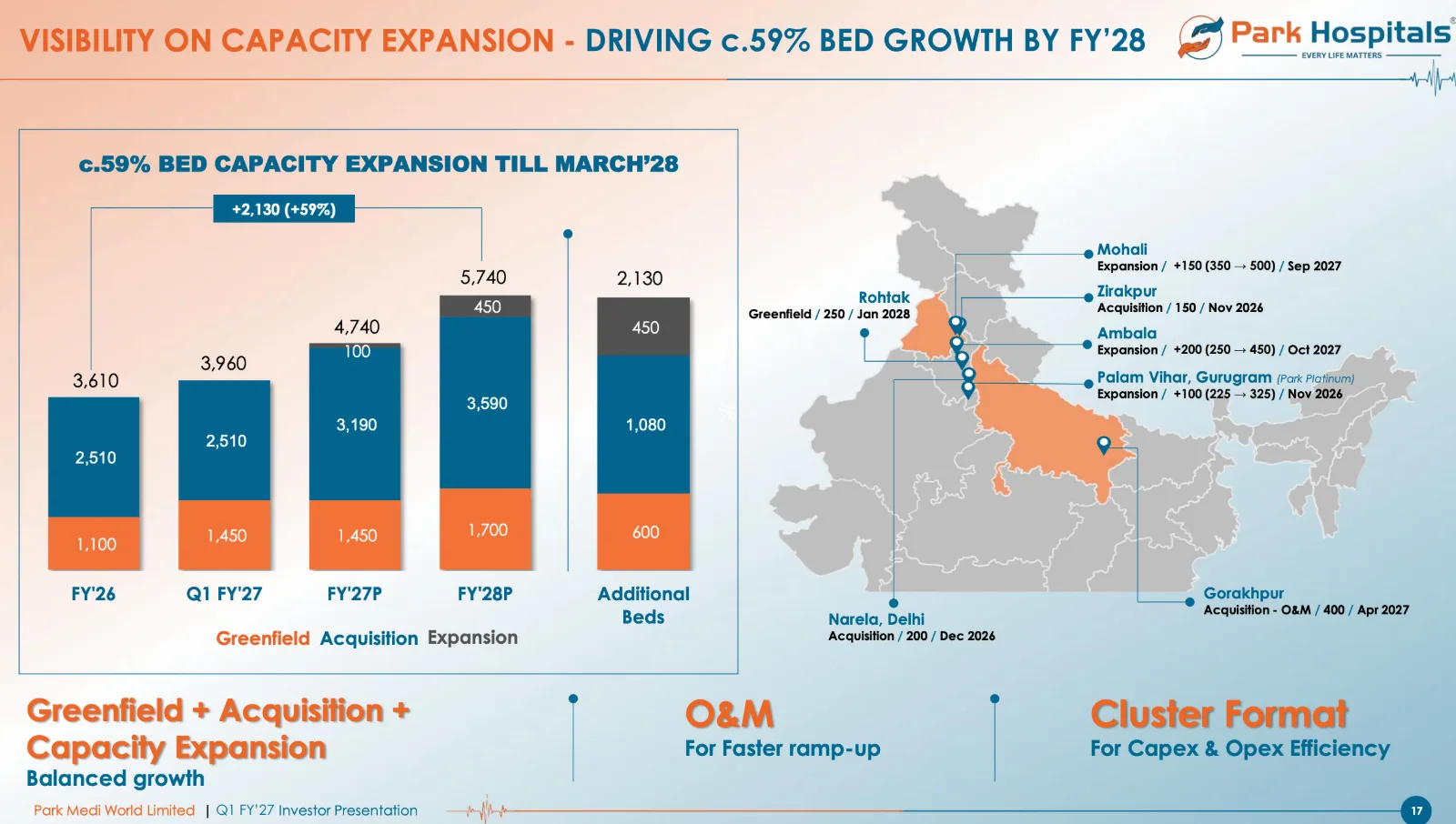
Park Medi World indicated that FY26 revenue was delivered broadly in line with guidance and expects FY27 EBITDA of around ₹530 crore, implying roughly 25% growth.
More interestingly, management has outlined a 22–24% revenue CAGR target over the next 10 years, with occupancy ramp-up and ARPOB growth among the key drivers.
Healthcare businesses can have a long gestation period.
New capacity doesn't immediately operate at mature utilisation. Over time, occupancy can improve, ARPOB can rise and the economics of the asset can change.
But a 10-year target is ultimately an assumption that needs to be tested quarter after quarter.
What to track:
Occupancy
ARPOB
New beds/capacity
Revenue per bed
EBITDA margins
Capex
ROCE
Actual growth versus long-term targets
Two New IPOs. First Q1 FY27 Concalls.
Two recently listed businesses Rentomojo and Steamhouse India, also conducted their first earnings calls after listing.
These are particularly interesting to follow because the first few concalls establish a baseline between what management says and what eventually gets delivered.
Rentomojo: Strong Growth, But No Formal FY27 Guidance Yet
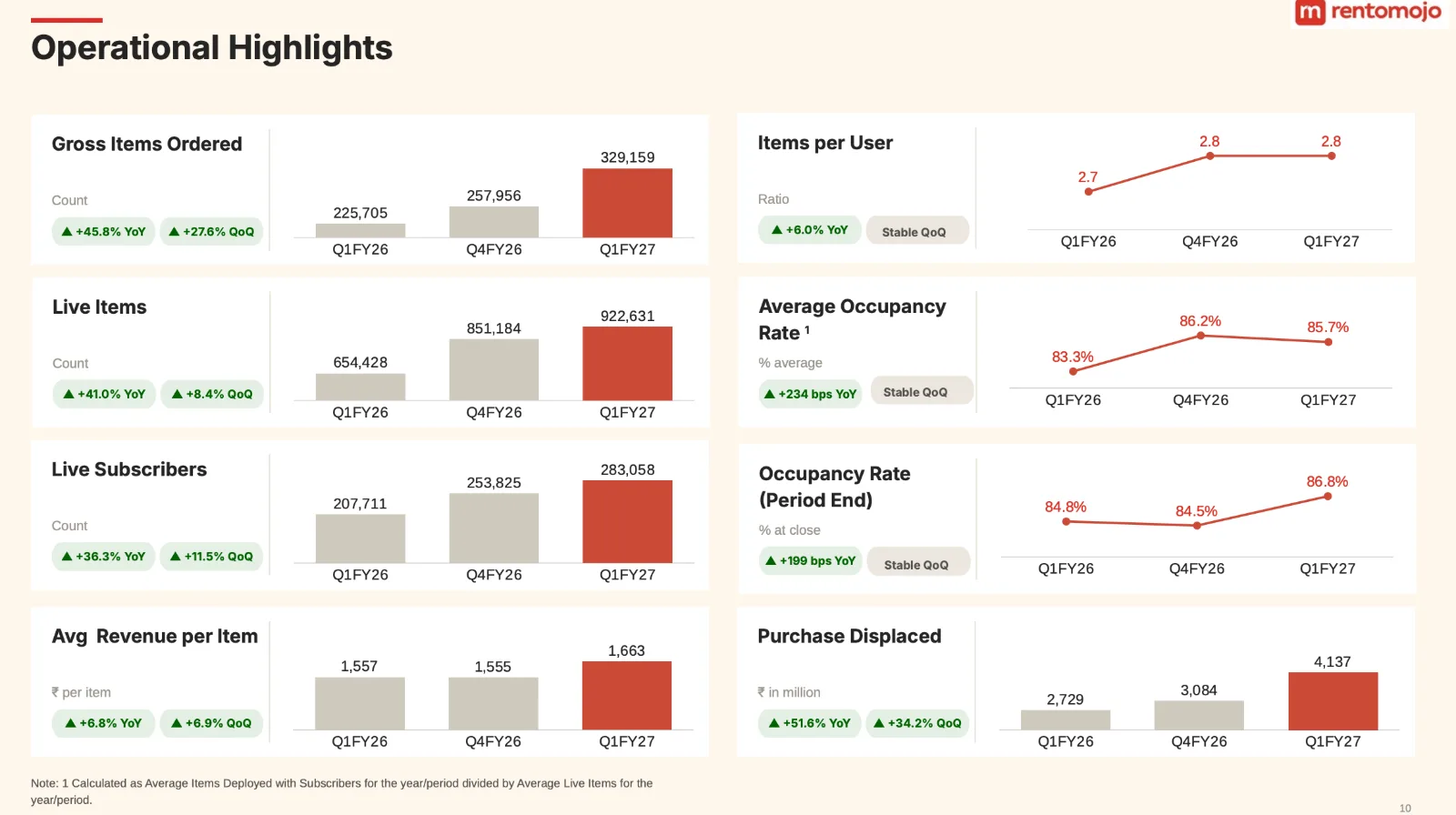
Rentomojo reported ₹126.3 crore of revenue, up 51% YoY, while normalized EBITDA increased 50% and normalized PAT increased 71%. Live subscribers grew 36% and items ordered increased 46%.
A few operating metrics stood out:
Average revenue per item increased 6% YoY to ₹1,663
Occupancy remained around 85–86%
Stores increased from 82 to 89
Organic traffic represented around 60% of traffic
Repeat behaviour was around 50%
Normalized ROCE remained above 26%
The business also appears to be generating growth without relying entirely on external capital. FY26 operating cash flow of around ₹173 crore broadly covered growth capex of ₹87.5 crore.
But there is an important point on the other side.
Management did not provide quantified FY27 guidance for new cities, store additions or gross block expansion. Management said it would deliberate on providing more guidance in the future.
The quarter also included a ₹11.37 crore exceptional fire loss, which management said was fully insured and had been disclosed before the IPO.
What we will track
Subscribers → Items per subscriber → Occupancy → Store expansion → ROCE → Cash generation
Steamhouse India: Volume Recovery, Higher Utilisation & Heavy Expansion
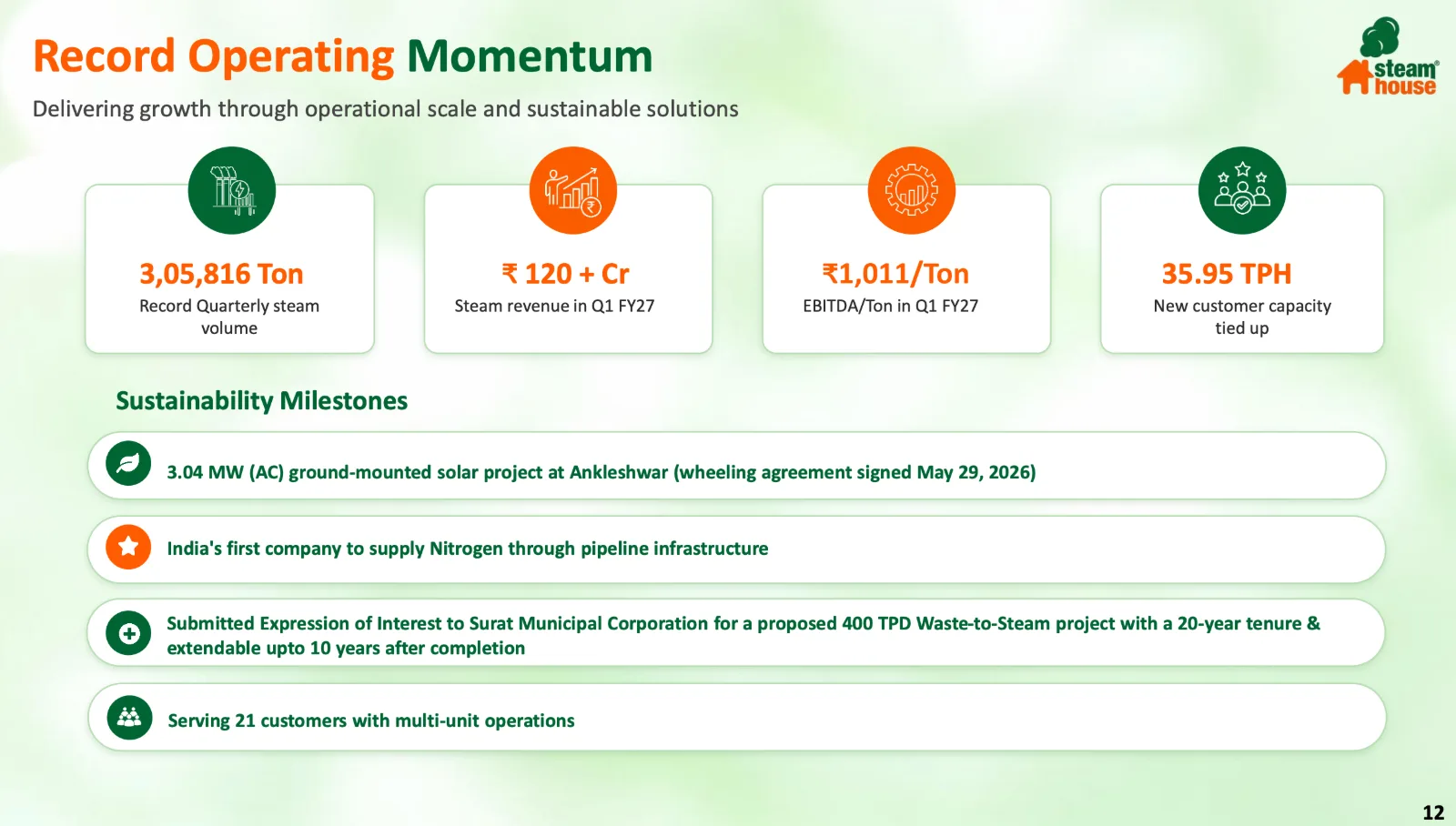
Steamhouse reported 16.7% YoY growth in steam volumes, while steam revenue increased 46%. EBITDA grew 60% and EBITDA per tonne increased to ₹1,011 from ₹737.
Capacity utilisation also improved to 41.4% from 36.1%, leaving significant headroom before management's stated optimum utilisation range of 60–65%.
One particularly interesting metric was customer stickiness:
~99.38% of Q1 revenue came from repeat customers, versus ~90.72% in FY26.
Management is targeting 20–25% volume growth in FY27, with four under-construction facilities expected to go live during FY27. Additional projects could take total steam distribution capacity from 345 TPH to approximately 705 TPH.
However, expansion also comes with capital requirements.
Gross debt increased to around ₹359 crore from ₹282 crore, with management expecting IPO proceeds to help repay higher-cost borrowings.
Another interesting part of the story is the potential shift towards a distribution-only model, where the company primarily invests in pipelines rather than the steam-generation infrastructure. Management believes this model can generate higher ROCE because of the lower capital requirement.
What we will track
Volume growth → Utilisation → EBITDA/tonne → New capacity → Capex → Debt → ROCE
Every day we'll pick the most useful management interviews, extract the business learnings, identify what matters, and most importantly, track what management said against what actually happens in the numbers.
See you tomorrow.
Amit
Disc: Not a Buy/Sell Recommendations.
#StockScans
Comments