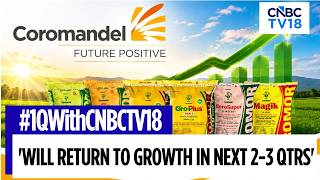
Coromandel International is India’s largest private-sector phosphatic fertiliser company and a holistic farm-solutions provider, reaching roughly two crore farmers every year. It was born in 1961 as Coromandel Fertilisers, a collaboration between American chemical companies and EID Parry, and commissioned its first complex fertiliser plant at Visakhapatnam in 1967 to feed India’s Green Revolution; over the decades EID Parry increased its stake until Coromandel became the flagship of the 125-year-old Murugappa Group. The recurring approach that explains everything else is backward integration - the company keeps reaching further upstream to own its raw materials, from rock phosphate mines in Senegal to phosphoric acid plants and joint ventures in Africa, so that it can run its factories at nearly full capacity while competitors scramble for inputs.
Business segments
Three engines built on the same farmer relationship - a giant nutrient business that supplies the bulk of the country’s phosphatic fertiliser, a crop protection arm that guards the harvest, and a retail network that puts both into the farmer’s hands.
1. Nutrient and allied businesses: India’s phosphatic breadbasket
The company is the largest private-sector maker of phosphatic fertiliser in India, with a 17.5% market share, and it runs its plants at close to 95% of capacity because it has locked up rock, acid and gas supplies across three continents.
- Backward integration that replaces imports - two new plants at Kakinada, a 2,000 tonnes-per-day sulphuric acid unit and a 650 tonnes-per-day phosphoric acid unit, were commissioned in March 2026, cutting the site’s imported acid requirement by more than half. An earlier sulphuric acid plant at Visakhapatnam had already made that unit self-sufficient, saving nearly Rs. 400 crore.
- A portfolio of nutrients, not just one bag - the company sold 42.8 lakh metric tonnes of complex fertilisers (DAP and NPK) and a record 8.4 lakh tonnes of single superphosphate (SSP) in FY26, making it the largest SSP marketer in India. It is also the number-one marketer of organic fertilisers and the pioneer in specialty nutrients, with 35% of its phosphatic sales coming from unique grades that competitors do not offer.
- Nano DAP: a new platform from its own labs - the company developed and patented a liquid nano-fertiliser inhouse, built a fully automated plant at Kakinada that can produce one crore bottles a year, and already commands roughly half the Indian nano-DAP market with close to 42 lakh bottles sold.
- The subsidy engine that funds it all - about 85% of the nutrient business’s revenue comes from government subsidy, and the company received INR 10,649 crores in subsidy payments during FY26, with INR 2,168 crores still outstanding at year-end. The government raised nutrient-based subsidy rates by 10% for nitrogen, phosphorus and sulphur for the Kharif 2026 season, which directly supports the pricing of every tonne sold.
2. Crop protection: the chemical shield for the harvest
A smaller but strategically essential business that makes the insecticides, fungicides and herbicides farmers need after the fertiliser is in the ground, now scaled up by the acquisition of a controlling stake in NACL Industries.
- Manufacturing that was bought, not just built - the company entered agrochemical manufacturing by acquiring Sabero Organics in 2011 and later the bio-pesticides business of EID Parry, giving it technical synthesis capacity and a portfolio of biological products.
- A recent acquisition that doubles the footprint - in 2024 the company acquired 53% equity in NACL Industries, a move that brings additional manufacturing scale and a broader crop-protection product line into the fold.
3. Rural retail: the last-mile shop that sells everything
A network of over 13,000 branded retail outlets - called Pradhan Mantri Kisan Samruddhi Kendras - that puts fertiliser, crop protection, seeds and soil-testing services within walking distance of the farmer.
- A store that is also an agronomist - the company offers soil and leaf testing through its advanced lab at Kakinada and 58 Nutri clinics, and the lab feeds recommendations to farmers’ mobile phones through the Gromor Nutri Advisory Portal, using a Salesforce CRM backbone.
- Built over two decades - the first rural retail store opened in Andhra in 2006-07, and the network has since grown to 13,385 outlets across key markets, making it one of the largest agri-input retail chains in the country.
- A channel for the company’s own brands first - the stores stock Coromandel’s fertilisers, crop-protection chemicals, specialty nutrients and organic products, which means the company captures margin at both the manufacturing and retail steps for a significant share of its volume.
Group structure and partners
Coromandel sits inside the 125-year-old Murugappa Group, with a web of subsidiaries and joint ventures that stretch from a rock phosphate mine in Senegal to a phosphoric acid plant in Tunisia and a gypsum-plaster venture in India - each one securing a raw material or monetising a by-product.
- Parent and flagship - the company is the flagship of the Murugappa Group, and its parent E.I.D. Parry started India’s first single superphosphate plant at Ranipet in 1906.
- By-product monetisation at home - a joint venture called StuccoEdge, 60% owned through subsidiary Coromandel Chemicals, turns phospho-gypsum waste from the fertiliser plants into gypsum plaster and building materials.
- Farm mechanisation partnership - the company has a joint venture with Yanmar and Mitsui (Yanmar Coromandel Agrisolutions Private Limited) for combine harvesters and rice transplanters, though its stake was diluted to 10.6% after a fund infusion by Yanmar in 2024.
 8:16
 9:07
 4:11
 3:04
 3:55
 19:05