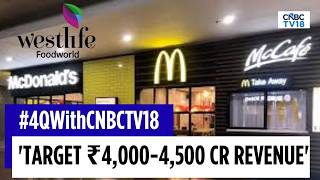
Westlife Foodworld is the company behind every McDonald’s in West and South India - the master franchisee that owns and runs the restaurants, not a distant brand licensor. It began with a single store in Mumbai’s Bandra in 1996 and has since built a network of 478 restaurants across 78 cities, all operated by its subsidiary Hardcastle Restaurants. The recurring idea that explains the business is a “glocal” model: a global brand and system, executed with a deeply Indian supply chain, a menu invented for local tastes, and a company-owned store footprint that keeps every customer touchpoint under its own control.
Business segments
Two engines that feed each other - a company-owned restaurant chain that serves millions of guests directly, and a farm-to-fork supply chain that makes that possible with roughly 99% of ingredients sourced inside India.
1. Company-owned McDonald’s restaurants: the store network that meets the customer
Every burger, coffee and McAloo Tikki sold in West and South India flows through a store Westlife itself owns and operates - the company is the retailer, not a sub-franchisor.
- Owned, not just branded - Westlife, through its subsidiary HRPL, holds the master franchise for McDonald’s in its territory and runs every restaurant itself, so it captures the full economics of each sale rather than collecting a thin royalty from third-party operators.
- Built around Indian tastes - the menu is anchored on burgers, chicken and coffee, but the biggest sellers include items created specifically for India, such as the McAloo Tikki Burger and Chicken Maharaja Mac, which means the offering is local comfort food served inside a global format.
- A channel for every occasion - guests can dine in, take away, use a drive-thru, order via the McDelivery app or collect from the kerb with On-the-Go, and the company stitches these together through a single app and loyalty programme so the experience feels seamless whether the customer is on the sofa or in the car.
- Digital is the front door - over three-quarters of sales now come through the mobile app, McDelivery platform, and in-store self-ordering kiosks, which gives Westlife direct data on what guests want and reduces its reliance on third-party delivery platforms for customer relationships.
- Value that builds habit - entry-level combo meals start at ₹69, and the company describes its ₹99 everyday meal as “trusted, predictable, and habit-forming,” so the pricing ladder is designed to bring people in frequently rather than only on payday.
2. The supply chain: a farm-to-fork engine that delivers consistency and cost control
Westlife built its own cold chain, grower network and supplier ecosystem over more than two decades - it is the largest investment the company has made and the reason a burger tastes the same in Mumbai and Mangalore.
- Grown to order - the company pioneered the cultivation of iceberg lettuce in India and worked with suppliers to develop a special potato variety for its French fries, so ingredients that were once imported are now produced domestically to its specifications.
- Sourced within a few hundred kilometres - tomatoes come from Western India, potatoes from Gujarat, dairy from the same state, buns from Maharashtra, jalapeños from Karnataka, coffee from Chikkamagaluru and lettuce from the Nilgiri Hills, which shortens the distance from field to restaurant and insulates against global supply shocks.
- Cold chain as insurance - temperature-controlled trucks and precision logistics deliver 99% of supplies on time at regulated temperatures, so the company can serve perishable food across a vast geography without breaking the cold chain that keeps it safe.
- Audited from farm to plate - 95% of products by value come from vendors covered under supplier workplace accountability audits, and the chicken used in McSpicy Fried Chicken goes through 64 separate tests for traceability, which turns a sprawling supplier base into a controlled system.
Group structure and partners
Westlife Foodworld is the listed holding company, but every restaurant, employee and customer transaction sits inside its wholly-owned subsidiary Hardcastle Restaurants - the entity that actually holds the McDonald’s licence.
- One subsidiary, one licence - Hardcastle Restaurants (HRPL) is the master franchisee under an agreement with McDonald’s signed in September 2022, giving it the exclusive right to own and operate McDonald’s restaurants in West and South India and to open new ones at approved locations.
- Royalty tied to growth - HRPL pays McDonald’s a continuing franchise fee as a percentage of restaurant sales; the rate for FY26 is 5.0%, provided network expansion targets are met, which aligns the cost of the brand licence with the company’s store-opening pace.
- Control stays with the founding family - the master franchise agreement requires Amit Jatia to remain in control of HRPL at all times, and because HRPL is wholly owned by Westlife Foodworld, that control extends to the listed company as well.
 5:07
 4:09
 8:52
 7:05
 5:41
 5:45