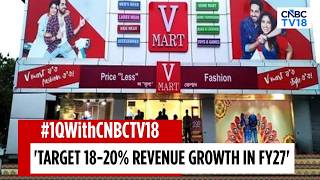
V-Mart Retail is a value-fashion retailer built on a simple belief - that looking good should not cost too much - and it has spent over two decades proving that model in the small towns and cities of “Bharat” that other organised retailers ignored. Founded in 2002 with a single store in Gujarat, the company now runs 577 stores under three brands - V-Mart, Unlimited, and LimeRoad - across 28 states, serving families who earn roughly ₹30,000 a month and shop for clothes only two or three times a year. The recurring idea that explains everything is “honest value pricing”: customers come back not because of discounts but because the company delivers relevant, affordable fashion season after season, funded entirely by its own cash flows with no long-term debt.
Business segments
Two retail chains at different stages of geographic maturity, plus a digital marketplace that doubles as the omnichannel backbone - all three selling affordable fashion to the same aspirational Indian family, just through different doors.
1. V-Mart: the flagship value chain for Bharat’s small towns
A company-owned chain of 478 stores that sells the entire family’s wardrobe - clothes, shoes, bags, and daily staples - under one roof in Tier-2, -3, and -4 cities, with nearly three-quarters of sales coming from repeat customers.
- One-stop family shop - the stores carry apparel (79% of revenue), non-apparel like footwear and toys (10%), and general merchandise including packaged food (11%), so a family can buy everything in a single trip; the V-Mart average transaction is ₹965.
- Private labels drive both fashion and margin - nine in-house brands such as Flick and Kidistan make up 66% of revenue and nearly 70% of apparel sales, giving the company control over design and cost in a way that pure resellers cannot match.
- Cluster-based expansion, not scattergun - new stores open within 50-150 km of an existing cluster, which builds local brand recognition, cuts supply-chain costs, and lets the company enter a market without betting on a single isolated location.
- Inventory tuned to local taste - a persona-based clustering model keeps 70-80% of the assortment common across stores while tailoring the rest to regional festivals, income profiles, and fashion sensibilities, so a store in Uttar Pradesh does not look identical to one in Tamil Nadu.
- Speed from design to shelf - the design-to-display cycle has been compressed to 70-75 days, with a 20-30 day rapid-refresh window layered on top of the core 90-day assortment plan, letting the chain chase a trend without overcommitting to inventory.
2. Unlimited: the South India bridgehead
A 99-store chain acquired from Arvind Fashions that gives V-Mart instant access to six southern states with a format and brand already known to local shoppers - now being expanded into smaller towns.
- Bought, not built from scratch - the FY22 acquisition delivered 74 operational stores, 7.8 lakh square feet of retail space, an established warehouse network, and a skilled front-end team, all at book value for roughly ₹150 Crore at closing.
- A distinct format for a distinct market - Unlimited stores average about 10,500 square feet and operate in high streets and malls, with a higher average selling price (₹441 for apparel) and a larger average transaction (₹1,658) than V-Mart, reflecting the different cost structure and customer profile of South India.
- Higher margin to offset higher costs - South India stores earn 3-5% more margin than the rest of the chain because the merchandise and pricing are differentiated, which is how the company absorbs the region’s steeper operating expenses.
- Right-sizing the footprint - after the acquisition, many large, high-rent Unlimited stores were closed; the company is now opening new Unlimited outlets in Tier-3 towns of southern India, applying the small-town playbook it perfected with V-Mart.
3. LimeRoad: the digital discovery engine
An online fashion marketplace that V-Mart bought in a slump sale, now serving as the single website and app for both store brands while earning commission on third-party vendor sales - and it already covers its own direct costs.
- Inventory-free marketplace - LimeRoad does not own the goods sold by its third-party vendors; it earns a commission (₹372 million in FY26) on every sale, which flows entirely to the gross margin line because there is no cost of goods attached.
- The endless aisle for physical stores - a customer standing in a V-Mart or Unlimited store can order any size, colour, or product not on the shelf through the LimeRoad app with a single click, and 45% of LimeRoad’s online orders are now fulfilled from V-Mart’s own inventory.
- Profitable at the contribution level - the marketplace is CM3-positive in high single digits, helped by a deliberate shift to prepaid orders, tighter returns management, and AI tools that cut losses in the vertical by nearly 70% year-on-year.
- A different customer, not a cannibal - LimeRoad targets the millennial, digital-first woman who may not see V-Mart as her brand, bringing in a shopper the physical stores would otherwise miss; half of LimeRoad’s business now comes from customers who buy both online and offline.
Omnichannel operations
Every store doubles as a mini-warehouse for online orders, and the company deliberately avoids buying digital customers - it uses the app to pull existing loyalists back to stores.
- One-click across 22,000 pin codes - the ‘One-Click’ Endless Aisle is live in 100% of stores, letting shoppers order from the full chain-wide inventory; it accounts for 30% of platform orders and serves over 1,470 customers a day.
- Digital as a loyalty loop, not a customer-acquisition cost sink - the company drives loyalty-based traffic to stores through digital prompts and has deliberately reduced offline marketing spend, aiming to avoid the high-cost model of large online players that “buy revenue”.
- Buy online, return in store - customers can purchase on LimeRoad and return or exchange at any V-Mart or Unlimited outlet, which lowers the friction that typically kills online apparel purchases.
Group structure and partners
All three brands sit inside a single listed company with no complex subsidiary web, run by a board where half the directors are independent and the Chairman is separate from the Managing Director.
- One entity, one segment - V-Mart, Unlimited, and LimeRoad all operate within V-Mart Retail Ltd itself; the company reports a single business segment (retail trade through a chain of stores) and has no subsidiaries, associates, or joint ventures as of FY24, with LimeRoad noted as a wholly-owned subsidiary in FY25.
- Acquisitions structured for clean integration - Unlimited was acquired via an Asset Transfer Agreement from Arvind Lifestyle Brands (a subsidiary of Arvind Fashions) for cash at book value plus contingent milestone payments; LimeRoad was bought as a going concern on a slump-sale basis from A.M. Marketplaces for ₹31.12 Crores in cash plus assumed liabilities of roughly ₹36.26 Crores.
- Governance recognised externally - the company holds what it calls a “Triple Crown of Governance”: the ICAI Silver Award for Excellence in Financial Reporting, the ICSI Award for Excellence in Corporate Governance, and the Golden Peacock Award for Excellence in Corporate Governance.
- Leadership in transition - founder Lalit Agarwal remains Managing Director; CFO Anand Agarwal was additionally appointed Chief Operating Officer effective July 2026 as part of a formal succession plan, while the LimeRoad founder departed in May 2024.
 3:46
 12:53
 8:04
 6:39
 9:49
 6:44